Simple Past Tense Made Easy: Complete English Grammar Guide for Beginners
Simple Past Tense Made Easy: Complete English Grammar Guide for Beginners
Introduction
Learning English grammar becomes much easier when you understand one tense at a time. One of the most important tenses in English is the Simple Past Tense. We use it every day to talk about actions that happened and finished in the past.
Whether you are a beginner or an intermediate learner, mastering the Simple Past Tense will help you speak English more naturally, write better sentences, and understand conversations more easily.
In this complete guide, you will learn the rules of the Simple Past Tense, sentence structures, common time expressions, regular and irregular verbs, examples from daily life, common mistakes, and practical exercises.
What Is the Simple Past Tense?
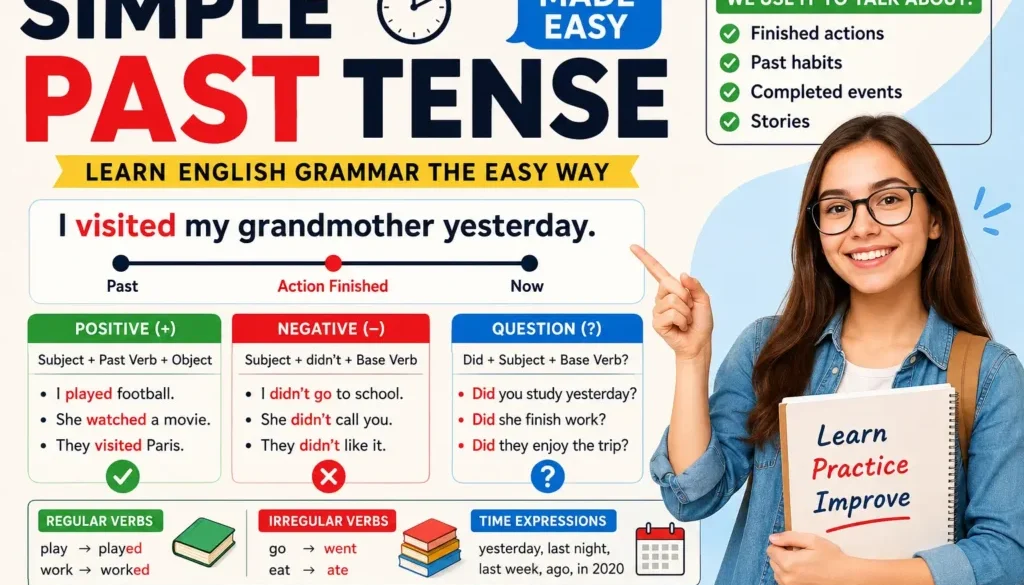
The Simple Past Tense is used to describe an action or event that started and finished in the past.
The action is completely finished.
Examples
- I visited my grandmother yesterday.
- She watched a movie last night.
- They played football after school.
- We traveled to Spain last summer.
- He cleaned his room this morning.
All of these actions happened in the past and are finished.
When Do We Use the Simple Past Tense?
The Simple Past Tense has several important uses.
1. To Talk About Finished Actions
Use it when something happened and finished at a specific time.
Examples
- I finished my homework.
- She cooked dinner.
- They arrived early.
- We opened the shop.
- He called me.
-
🎯 Stop wasting time on random resources. Discover the English books that can help you build confidence in grammar, vocabulary, speaking, and writing. https://amzn.to/4c3ulsh
2. To Talk About Past Habits
It also describes habits or repeated actions in the past.
Examples
- I played outside every evening.
- My father walked to work every day.
- We visited our grandparents every weekend.
- She listened to music after school.
- They watched cartoons every Saturday.
3. To Tell Stories
Most stories are written using the Simple Past Tense.
Example
Yesterday, Sarah woke up early. She made breakfast and left home at eight o’clock. She walked to the bus stop, met her friend, and they went to school together.
4. To Describe Completed Events
Examples
- The concert started at 8 p.m.
- The meeting ended at 5 p.m.
- The baby smiled.
- It rained all day.
- The train arrived on time.
Structure of the Simple Past Tense
Positive Sentences
Formula
Subject + Past Form of the Verb + Object
Examples
- I worked hard.
- She studied English.
- We visited London.
- They watched TV.
- He played basketball.
Negative Sentences
Formula
Subject + did not (didn’t) + base verb
Examples
- I did not go to school.
- She didn’t watch TV.
- They didn’t play football.
- We didn’t eat breakfast.
- He didn’t finish his homework.
Remember:
After didn’t, always use the base form of the verb.
Correct:
- She didn’t go.
Incorrect:
- She didn’t went.
🎯 Stop wasting time on random resources. Discover the English books that can help you build confidence in grammar, vocabulary, speaking, and writing. https://amzn.to/4fGmKlK
Questions
Formula
Did + Subject + Base Verb?
Examples
- Did you study yesterday?
- Did she call you?
- Did they arrive early?
- Did he cook dinner?
- Did we win the game?
Short Answers
Positive
- Yes, I did.
- Yes, she did.
- Yes, they did.
Negative
- No, I didn’t.
- No, she didn’t.
- No, they didn’t.
Regular Verbs
Regular verbs add -ed to make the past tense.
| Base Verb | Past Form |
|---|---|
| play | played |
| watch | watched |
| clean | cleaned |
| work | worked |
| help | helped |
| cook | cooked |
| visit | visited |
| open | opened |
| wash | washed |
| learn | learned |
Examples
- I played tennis.
- She worked late.
- We cleaned the house.
- They watched a film.
Irregular Verbs
Irregular verbs do not follow a fixed rule.
| Base Verb | Past Form |
|---|---|
| go | went |
| eat | ate |
| see | saw |
| come | came |
| buy | bought |
| take | took |
| give | gave |
| write | wrote |
| make | made |
| have | had |
Examples
- I went to school.
- She ate breakfast.
- They bought a new car.
- He wrote a letter.
- We saw our teacher.
Time Expressions Used with the Simple Past
These words often appear with the Simple Past Tense.
- Yesterday
- Last night
- Last week
- Last month
- Last year
- Two days ago
- A week ago
- In 2020
- This morning
- Earlier today
Examples
- I met him yesterday.
- She traveled last summer.
- We finished the project two days ago.
- He graduated in 2021.
Daily Life Examples
- I brushed my teeth.
- She cooked breakfast.
- We walked to school.
- They cleaned the kitchen.
- He answered the phone.
- I bought some bread.
- She visited her aunt.
- We enjoyed the party.
- They studied together.
- He finished work early.
School Examples
- The teacher explained the lesson.
- I answered the question.
- We completed the exercise.
- She passed the exam.
- They joined the class.
- He forgot his notebook.
- We practiced English.
- I asked my teacher for help.
- She wrote an essay.
- They finished the test.
Travel Examples
- We visited Paris.
- I booked a hotel.
- She packed her suitcase.
- They took many photos.
- He missed the train.
- We enjoyed our vacation.
- I flew to Italy.
- She explored the city.
- They stayed at a hotel.
- We returned home safely.
Conversation Examples
Example 1
A: What did you do yesterday?
B: I visited my grandparents.
A: Did you enjoy your trip?
B: Yes, I did.
A: Where did you go last weekend?
B: I went to the beach.
A: Did you buy anything?
B: Yes, I bought a new backpack.
Common Mistakes
Incorrect
I didn’t went home.
Correct
I didn’t go home.
Incorrect
Did she watched TV?
Correct
Did she watch TV?
Incorrect
He goed to school.
Correct
He went to school.
Tips to Master the Simple Past Tense
- Learn the most common irregular verbs.
- Read short stories every day.
- Practice speaking about yesterday.
- Write a daily journal using past tense.
- Listen to English conversations.
- Complete grammar exercises regularly.
- Read English books and articles.
- Watch English videos with subtitles.
- Practice asking and answering questions.
- Review new verbs every week.
Practice Exercises
Choose the correct answer.
1.
She ____ to school yesterday.
a) goes
b) went
c) go
Answer: b
2.
Did you ____ your homework?
a) finished
b) finish
c) finishing
Answer: b
3.
They ____ football last Sunday.
a) played
b) play
c) playing
Answer: a
4.
I ____ breakfast this morning.
a) ate
b) eat
c) eating
Answer: a
5.
We ____ a movie last night.
a) watched
b) watch
c) watches
Answer: a
Frequently Asked Questions (FAQ)
What is the Simple Past Tense?
The Simple Past Tense describes actions or events that started and finished in the past.
When should I use the Simple Past Tense?
Use it for completed actions, past habits, finished events, and storytelling.
How do I make negative sentences?
Use did not (didn’t) + base verb.
Example:
She didn’t study.
How do I ask questions?
Use Did + subject + base verb?
Example:
Did you call your friend?
Why are irregular verbs important?
Irregular verbs do not follow the “-ed” rule, so they must be memorized through practice.
Conclusion
The Simple Past Tense is one of the first grammar topics every English learner should master. It helps you talk about yesterday, last week, your childhood, vacations, school experiences, and many other past events. By learning the rules, practicing regular and irregular verbs, and using the tense in daily conversations, you will become more confident in speaking and writing English.
Remember that improvement comes with regular practice. Read English stories, write about your day, and speak as much as possible. The more you use the Simple Past Tense, the more natural it will become.