
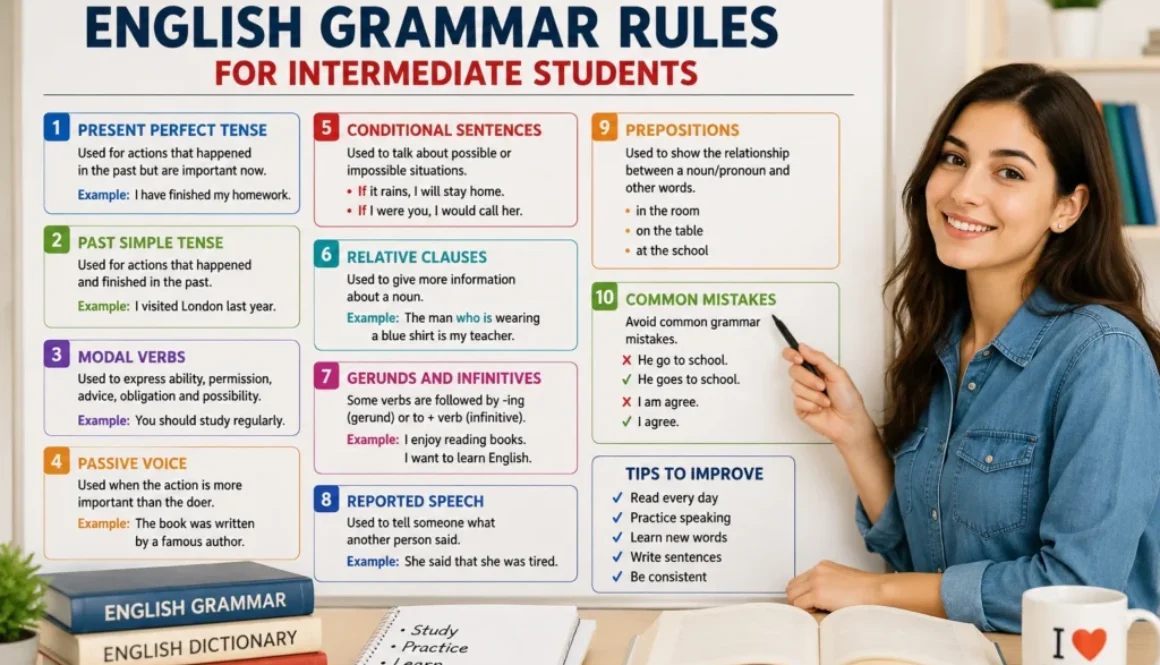
The Most Important English Grammar Rules for Intermediate Students
The Most Important English Grammar Rules for Intermediate Students
Learning English grammar is very important if you want to speak English correctly and confidently. Many students know basic English, but intermediate students need to improve their grammar to speak more naturally and clearly. Good grammar helps you in speaking, writing, reading, and listening.
In this English grammar lesson, you will learn the most important grammar rules for intermediate students using simple English and many examples. This guide will help you improve your English skills step by step.
English grammar rules are important for:
- Speaking English correctly
- Writing better sentences
- Improving English fluency
- Understanding native speakers
- Passing English exams
- Improving communication skills
This post includes important English grammar topics with easy explanations and examples for daily English use.
1. Present Perfect Tense
The present perfect tense is used for actions that happened in the past but are important now.
Structure
Positive:
Subject + have/has + past participle
Examples:
- I have finished my homework.
- She has visited Turkey many times.
- We have watched that movie before.
- He has cleaned his room.
- They have learned English for three years.
Negative:
- I have not seen him today.
- She has not finished her work.
- We have not eaten dinner yet.
Questions:
- Have you finished your homework?
- Has she called you?
- Have they arrived?
Important Keywords
already, yet, ever, never, since, for, just
More Examples:
- I have already eaten breakfast.
- She has never traveled abroad.
- We have lived here for five years.
- He has studied English since 2020.
The present perfect tense is one of the most important English grammar rules for intermediate learners because native speakers use it every day.
2. Difference Between Present Perfect and Simple Past
Many English learners confuse these tenses.
Simple Past
Used for finished actions in the past.
Examples:
- I visited London last year.
- She watched TV yesterday.
- We played football last weekend.
Present Perfect
Used when the time is not important or the action affects the present.
Examples:
- I have visited London many times.
- She has watched this movie before.
- We have played together for years.
Compare:
- I lost my keys yesterday.
- I have lost my keys. (I cannot find them now.)
Understanding these English grammar rules helps improve speaking and writing skills.
3. Modal Verbs
Modal verbs are very important in English grammar.
Common Modal Verbs:
can, could, should, must, may, might, will, would
Can / Could
Examples:
- I can swim.
- She can speak English well.
- Could you help me?
- When I was young, I could run fast.
Should
Used for advice.
Examples:
- You should study every day.
- He should eat healthy food.
- We should practice English more.
Must
Used for strong obligation.
Examples:
- You must wear a seatbelt.
- Students must do their homework.
- I must call my mother.
Might / May
Used for possibility.
Examples:
- It may rain today.
- She might come later.
- We may travel next month.
Modal verbs are very common in spoken English and daily conversations.
4. Passive Voice
The passive voice is used when the action is more important than the person who does it.
Structure:
Subject + be + past participle
Examples:
- The cake was made by my mother.
- English is spoken in many countries.
- The room was cleaned yesterday.
- The homework was finished on time.
More Examples:
- The book was written by a famous author.
- The car was repaired last week.
- The window was broken during the storm.
The passive voice is common in English writing and formal English.
5. Conditional Sentences
Conditional sentences talk about possibilities and situations.
First Conditional
Used for real future possibilities.
Structure:
If + present simple, will + verb
Examples:
- If it rains, I will stay home.
- If you study hard, you will pass the exam.
- If she calls me, I will answer.
Second Conditional
Used for unreal or imaginary situations.
Structure:
If + past simple, would + verb
Examples:
- If I were rich, I would travel the world.
- If she had more time, she would learn Spanish.
- If we lived near the beach, we would swim every day.
Conditional sentences are important for speaking naturally in English.
6. Relative Clauses
Relative clauses give extra information.
Relative Pronouns:
who, which, that, where
Examples:
- The man who lives next door is friendly.
- This is the book that I bought yesterday.
- The city where I was born is beautiful.
- She has a dog which is very smart.
More Examples:
- The teacher who teaches us is kind.
- I like movies that have happy endings.
- This is the café where we met.
7. Gerunds and Infinitives
Some verbs are followed by gerunds (-ing) or infinitives (to + verb).
Gerunds
Examples:
- I enjoy reading books.
- She likes cooking.
- They love traveling.
Infinitives
Examples:
- I want to learn English.
- He decided to study harder.
- We hope to visit Spain.
More Examples:
- She enjoys listening to music.
- I need to buy a new phone.
- They started working early.
8. Reported Speech
Reported speech tells what another person said.
Direct Speech:
She said, “I am tired.”
Reported Speech:
She said that she was tired.
Examples:
- He said that he liked football.
- My friend told me that she was busy.
- They said that they would come later.
More Examples:
- She told me that she loved English.
- He said that he could help us.
- My teacher said that practice was important.
Reported speech is very useful in conversations and writing.
9. Common Prepositions
Prepositions are small words, but they are very important in English grammar.
In
- in the room
- in the car
- in Morocco
On
- on the table
- on Monday
- on the wall
At
- at school
- at night
- at the bus station
More Examples:
- She is in the kitchen.
- The picture is on the wall.
- We arrived at the airport early.
10. Common Grammar Mistakes
Intermediate students often make grammar mistakes.
Incorrect:
He go to school every day.
Correct:
He goes to school every day.
Incorrect:
I am agree.
Correct:
I agree.
Incorrect:
She don’t like coffee.
Correct:
She doesn’t like coffee.
Tips to Improve English Grammar
- Read English books and articles every day.
- Watch English videos and listen carefully.
- Practice speaking English daily.
- Learn new vocabulary regularly.
- Write sentences using new grammar rules.
- Review grammar lessons often.
- Practice with exercises and conversations.
Improving English grammar takes time, but daily practice helps a lot.
Final Thoughts
Learning important English grammar rules helps intermediate students speak and write English more clearly and confidently. Grammar is the foundation of good communication. When you understand grammar well, you can express your ideas easily and naturally.
Try to practice these grammar rules every day. Use them in conversations, writing, and reading. Little by little, your English will become stronger and more fluent.
The best way to improve English grammar is to practice regularly and never stop learning.