Common English Preposition Mistakes and How to Avoid Them
Common Preposition Mistakes in English
Prepositions are small words, but they can cause big problems for English learners.
Words such as in, on, at, to, for, from, by, with, about, and of are extremely common in English. However, choosing the correct preposition is not always easy. In many cases, learners translate directly from their first language, which can lead to mistakes.
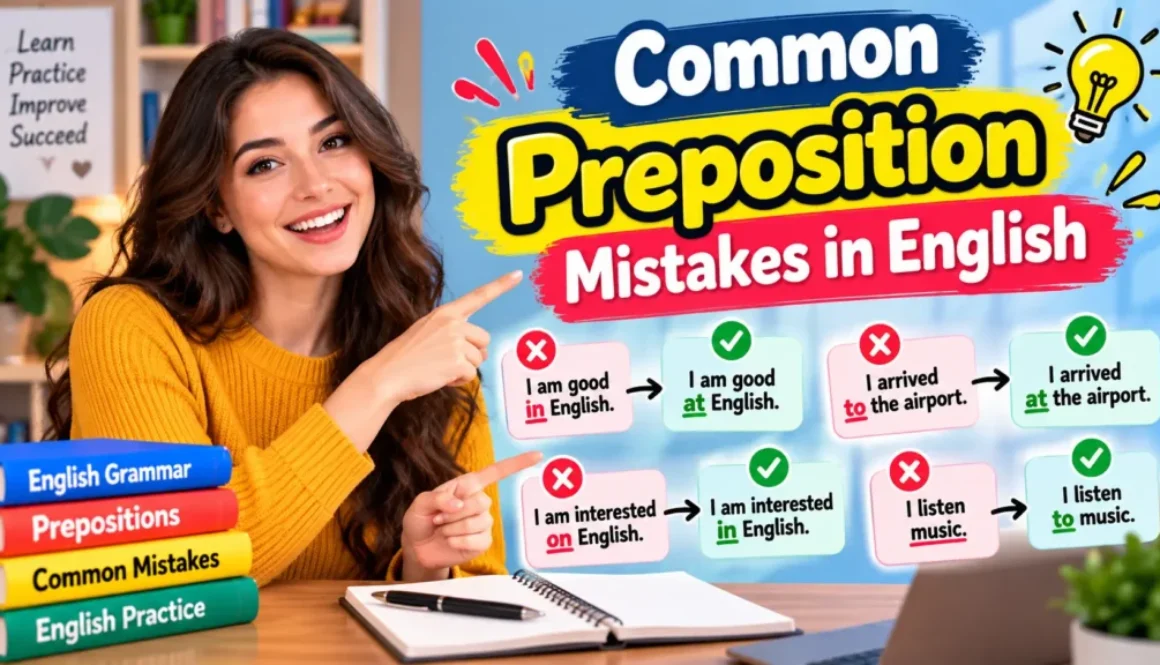
For example, many learners say:
❌ I am good in English.
But the correct sentence is:
✅ I am good at English.
Another common mistake is:
❌ I arrived to the airport.
The correct sentence is:
✅ I arrived at the airport.
The good news is that you can learn these mistakes and avoid them with practice.
In this guide, you will learn the most common preposition mistakes in English, including mistakes with time, place, movement, transportation, verbs, adjectives, and common expressions.
1. Mistakes with “In,” “On,” and “At”
One of the most common problems in English is knowing when to use in, on, and at.
These three prepositions are often used to talk about time and place.
In
We commonly use in with:
- months
- years
- seasons
- countries
- cities
- large areas
Examples:
✅ I was born in 2000.
✅ She was born in July.
✅ We live in Morocco.
✅ He works in London.
✅ I like studying in the morning.
Common mistake:
❌ I was born on 2000.
✅ I was born in 2000.
2. Using “On” Correctly
We commonly use on with:
- days
- dates
- surfaces
Examples:
✅ I will see you on Monday.
✅ My birthday is on June 15th.
✅ The book is on the table.
✅ There is a picture on the wall.
Common mistake:
❌ I will see you in Monday.
✅ I will see you on Monday.
3. Using “At” Correctly
We often use at with:
- specific times
- specific places
- certain locations
Examples:
✅ I wake up at 7 o’clock.
✅ The class starts at 9:00.
✅ She is waiting at the bus stop.
✅ We met at the airport.
Common mistake:
❌ I wake up on 7 o’clock.
✅ I wake up at 7 o’clock.
Easy rule:
Think about it this way:
IN → larger periods/areas
ON → days and dates/surfaces
AT → specific times/points
4. “Arrive In” or “Arrive At”?
The verb arrive is another common source of mistakes.
We usually use:
arrive in + city/country
arrive at + specific place
Examples:
✅ We arrived in Paris.
✅ She arrived in Morocco yesterday.
✅ They arrived at the airport.
✅ I arrived at the station at 8:00.
Common mistake:
❌ We arrived to Paris.
✅ We arrived in Paris.
❌ She arrived to the airport.
✅ She arrived at the airport.
5. “Go To” vs. “Go Home”
We normally use to when talking about movement toward a place.
Examples:
✅ I go to school every day.
✅ She went to work.
✅ We are going to the supermarket.
However, there is an important exception.
We normally say:
✅ I am going home.
Not:
❌ I am going to home.
We also say:
✅ He came home late.
❌ He came to home late.
The word home often does not need to when it follows verbs of movement.
6. “Good At” Not “Good In”
The adjective good is commonly followed by at when we talk about someone’s ability.
Correct:
✅ She is good at English.
✅ He is good at football.
✅ I am good at cooking.
Incorrect:
❌ She is good in English.
❌ He is good in football.
Remember:
good at + activity/skill
More examples:
✅ I am good at speaking English.
✅ She is good at mathematics.
✅ They are good at solving problems.
7. “Interested In” Not “Interested On”
The adjective interested is followed by in.
Correct:
✅ I am interested in English.
✅ She is interested in photography.
✅ He is interested in learning Spanish.
Incorrect:
❌ I am interested on English.
❌ She is interested on photography.
A useful pattern is:
be interested in + noun/gerund
For example:
✅ I am interested in learning English.
8. “Afraid Of” Not “Afraid From”
The correct preposition after afraid is of.
Correct:
✅ She is afraid of spiders.
✅ He is afraid of dogs.
✅ I am afraid of flying.
Incorrect:
❌ She is afraid from spiders.
❌ I am afraid from flying.
Remember:
afraid of + noun/gerund
9. “Listen To” Not “Listen”
The verb listen is normally followed by to when we say what we are listening to.
Correct:
✅ I listen to music every day.
✅ She is listening to the teacher.
✅ Please listen to me.
Incorrect:
❌ I listen music every day.
❌ Listen me!
The correct sentence is:
✅ Listen to me!
This is an especially common mistake among English learners.
10. “Wait For” Not “Wait”
When we talk about the person or thing we are waiting for, we use for.
Correct:
✅ I am waiting for my friend.
✅ She is waiting for the bus.
✅ We waited for two hours.
Incorrect:
❌ I am waiting my friend.
❌ She is waiting the bus.
Remember:
wait for + person/thing
11. “Depend On” Not “Depend Of”
The verb depend is followed by on.
Correct:
✅ It depends on the weather.
✅ Success depends on hard work.
✅ It depends on you.
Incorrect:
❌ It depends of the weather.
The expression is:
depend on
This is one of the most useful verb-preposition combinations to learn.
12. “Pay For” Something
When we talk about the thing we buy or the service we receive, we normally use pay for.
Correct:
✅ I paid for the meal.
✅ She paid for the ticket.
✅ He paid for his new phone.
Incorrect:
❌ I paid the meal.
❌ She paid the ticket.
However, remember that pay someone is different:
✅ I paid the waiter.
So:
pay for something
but
pay someone
13. “Married To” Not “Married With”
Another common mistake involves the adjective married.
Correct:
✅ She is married to John.
✅ He is married to a doctor.
Incorrect:
❌ She is married with John.
In English, we say:
be married to someone
14. “Different From” Not “Different With”
When comparing two things, we commonly use different from.
Correct:
✅ This car is different from my old car.
✅ English is different from French.
Incorrect:
❌ This car is different with my old car.
For standard English, remember:
different from
15. “Good For” vs. “Good At”
Be careful because good at and good for have different meanings.
Good at = ability
✅ She is good at English.
This means she has a good ability in English.
Good for = beneficial
✅ Exercise is good for your health.
This means exercise has a positive effect on your health.
Compare:
He is good at football.
= He plays football well.
Football is good for his health.
= Football has a positive effect on his health.
16. “By” vs. “With”
These two prepositions can also be confusing.
We often use by to talk about the method or means of doing something.
Examples:
✅ I go to work by bus.
✅ She traveled by train.
✅ We sent the information by email.
We often use with when talking about a tool or object.
✅ I cut the bread with a knife.
✅ He wrote the letter with a pen.
Compare:
I went there by car.
I opened the door with a key.
17. Transportation: “By” vs. “On”
Another common mistake is using by incorrectly with transportation.
We say:
✅ I travel by bus.
✅ She goes by train.
✅ We traveled by plane.
But when we are talking about being physically on a particular vehicle, we can use on.
✅ I am on the bus.
✅ She is on the train.
✅ They are on the plane.
So:
travel by bus
but:
be on the bus
18. “Since” vs. “For”
These two prepositions are very important when talking about time.
Since
Use since with the starting point.
✅ I have lived here since 2020.
✅ She has worked here since Monday.
✅ We have known each other since 2015.
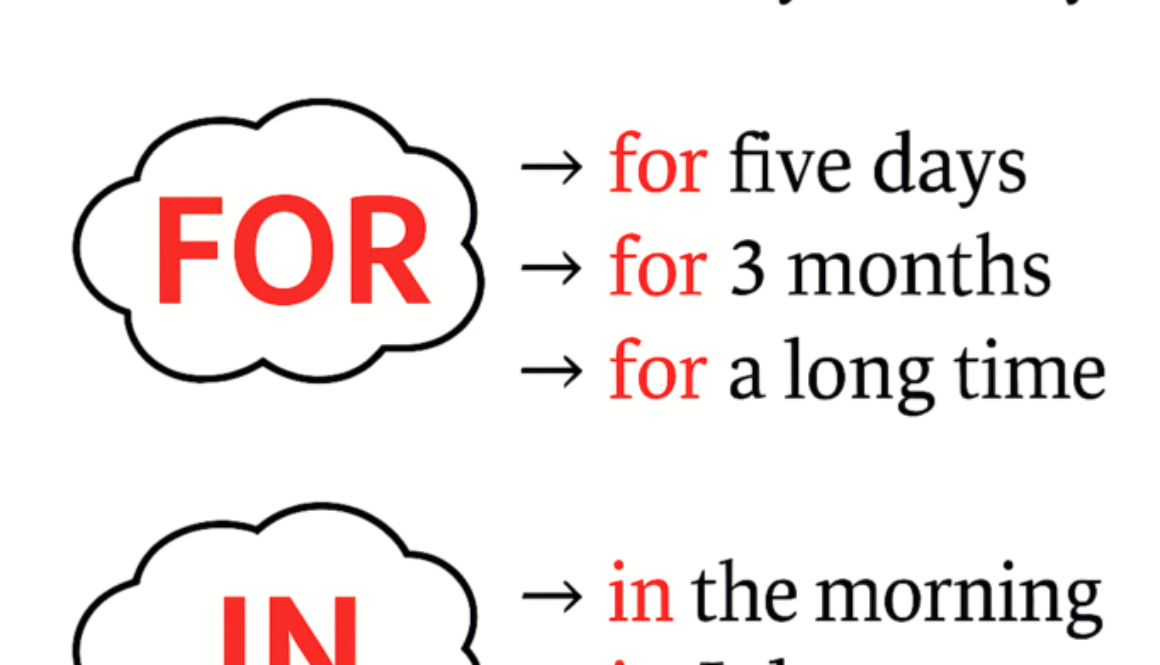
For
Use for with a period of time.
✅ I have lived here for six years.
✅ She has worked here for three days.
✅ We have known each other for ten years.
Easy rule:
since + starting point
for + length of time
19. “Between” vs. “Among”
Use between when talking about two people or things, and it can also be used for distinct individual items in larger groups.
Examples:
✅ The restaurant is between the bank and the hotel.
✅ There is an agreement between the two companies.
We commonly use among when talking about people or things considered as a group.
✅ She was sitting among her friends.
✅ He felt comfortable among the students.
20. How to Avoid Preposition Mistakes
Learning prepositions is not only about memorizing long grammar rules. One of the best ways to improve is to learn common word combinations.
Instead of learning:
interested = interested + ?
Learn the complete expression:
interested in
Instead of learning:
listen = listen + ?
Learn:
listen to
Instead of learning:
good = good + ?
Learn:
good at
This method is called learning collocations or common word combinations.
Create your own list:
- good at
- interested in
- afraid of
- listen to
- wait for
- depend on
- arrive at
- arrive in
- pay for
- married to
- different from
- famous for
- proud of
- tired of
- worried about
The more you see and use these combinations, the easier they become.
Common Preposition Mistakes: Quick Correction Table
| ❌ Incorrect | ✅ Correct |
|---|---|
| Good in English | Good at English |
| Interested on English | Interested in English |
| Listen music | Listen to music |
| Wait me | Wait for me |
| Arrive to the airport | Arrive at the airport |
| Arrive to Morocco | Arrive in Morocco |
| Afraid from dogs | Afraid of dogs |
| Married with him | Married to him |
| Depend of | Depend on |
| Pay the ticket | Pay for the ticket |
| Different with | Different from |
| Since five years | For five years |
| For 2020 | Since 2020 |
| Go to home | Go home |
Final Tips for Learning English Prepositions
Prepositions may seem difficult because there is not always one simple rule that explains every use. However, you can improve quickly by focusing on the expressions you use most often.
First, do not translate every expression directly from your first language. English often uses a different preposition.
Second, learn prepositions together with the words that usually follow them.
For example:
❌ Learn only interested.
✅ Learn interested in.
❌ Learn only listen.
✅ Learn listen to.
Third, read English regularly. When you read articles, stories, or conversations, pay attention to prepositions. Write down useful expressions and try to use them in your own sentences.
Finally, practice. Write five sentences every day using expressions such as good at, interested in, afraid of, listen to, wait for, depend on, and proud of.
Remember that making mistakes is a normal part of learning English. The important thing is to notice your mistakes, understand the correct form, and use it again.
With regular practice, common preposition mistakes will become much easier to avoid.