
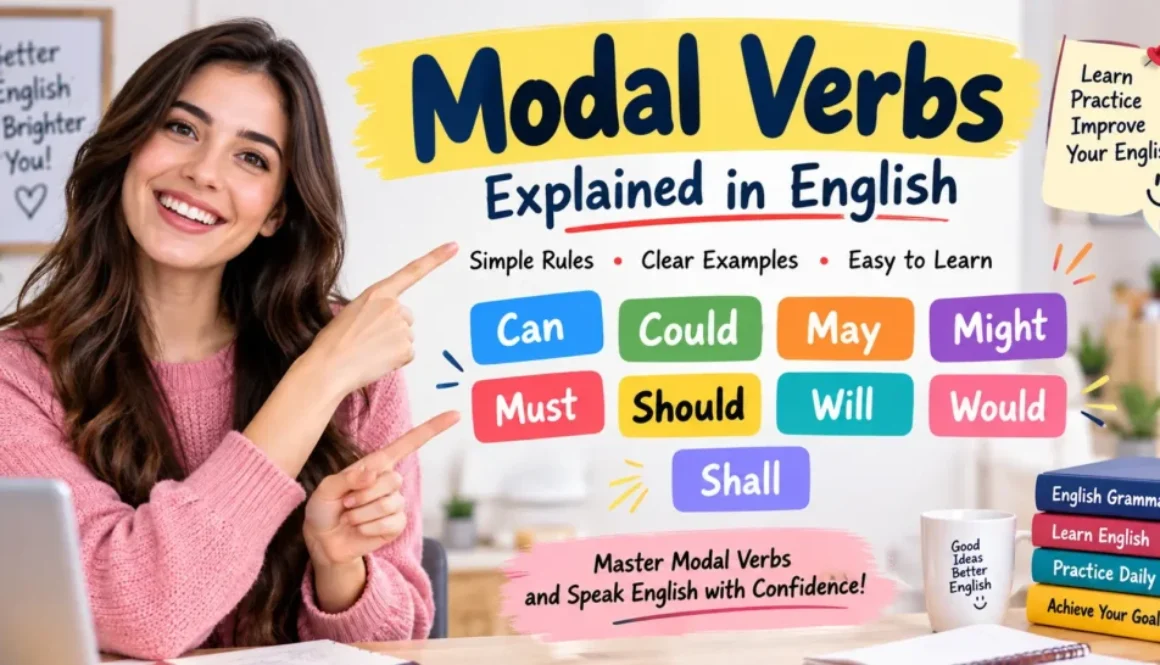
Modal Verbs Explained: Can, Could, May, Might, Must and Should
Modal Verbs in English: Complete Guide to Can, Could, May, Might, Must, Should, Will and Would
Modal verbs are some of the most important verbs in English grammar. They help us talk about ability, possibility, permission, advice, obligation, necessity, probability, requests, and future intentions.
If you are learning English, understanding modal verbs can help you communicate more naturally and confidently. Words such as can, could, may, might, must, should, will, would, and shall are used every day in conversations, emails, lessons, and formal writing.
In this complete guide, you will learn what modal verbs are, how to use modal verbs correctly, the rules of modal verbs, common examples, and the differences between important modal verbs.
What Are Modal Verbs in English?
Modal verbs are special auxiliary verbs that are used with a main verb to express a particular meaning or attitude.
Common modal verbs include:
-
Can
-
Could
-
May
-
Might
-
Must
-
Should
-
Will
-
Would
-
Shall
For example:
I can swim.
Here, can expresses ability.
You should study more.
Here, should expresses advice.
It might rain tomorrow.
Here, might expresses possibility.
Modal verbs are followed by the base form of the verb.
Basic structure:
Subject + modal verb + base verb
Examples:
-
I can speak English.
-
She should study harder.
-
They must leave now.
-
We might visit London.
-
He will call you later.
Notice that we do not normally use to after a modal verb.
❌ She can to swim.
✅ She can swim.
The Main Uses of Modal Verbs
Modal verbs have several important uses in English. Let’s look at them one by one.
1. Can for Ability
We use can to talk about something that someone is able to do.
Examples:
-
I can speak English.
-
She can drive a car.
-
He can play the guitar.
-
They can swim very well.
-
My brother can cook.
Negative form
The negative form is cannot or can’t.
Examples:
-
I can’t swim.
-
She can’t drive.
-
He cannot speak Spanish.
Questions with can
We can use can to ask about ability.
-
Can you swim?
-
Can she speak English?
-
Can he drive?
Example:
Can you speak English?
Yes, I can.
2. Could for Past Ability
We often use could to talk about general ability in the past.
Examples:
-
When I was young, I could run very fast.
-
She could speak English when she was ten.
-
My grandfather could swim very well.
-
We could play outside for hours.
Compare:
I can swim.
This means I have the ability now.
I could swim when I was five.
This talks about ability in the past.
3. Can for Permission
We can use can to ask for or give permission.
Examples:
-
Can I use your phone?
-
Can I sit here?
-
Can we leave now?
-
You can use my computer.
-
You can go home.
For example:
Can I open the window?
Yes, you can.
In everyday English, can is very common for permission.
4. May for Permission
May can also be used to ask for permission. It is often considered more formal or polite than can.
Examples:
-
May I come in?
-
May I ask you a question?
-
May I use your phone?
-
May we leave now?
Compare:
Can I ask you a question?
Common and natural in everyday conversation.
May I ask you a question?
More formal and polite.
5. Could for Polite Requests
We often use could when making polite requests.
Examples:
-
Could you help me?
-
Could you open the door?
-
Could you speak more slowly?
-
Could you give me some advice?
-
Could you send me the information?
Compare:
Can you help me?
and
Could you help me?
Both are correct, but could often sounds more polite or less direct.
6. May and Might for Possibility
We use may and might to talk about things that are possible.
Examples:
-
It may rain tomorrow.
-
It might rain tonight.
-
She may come to the party.
-
He might be busy.
-
They may arrive late.
For example:
I don’t know where Ali is. He might be at home.
This means that being at home is one possible explanation.
May vs. Might
In many situations, may and might can both express possibility.
-
She may come later.
-
She might come later.
Might can sometimes suggest a weaker possibility, but in everyday English the difference is often small.
7. Must for Strong Obligation
We use must when something is necessary or obligatory.
Examples:
-
You must wear a seat belt.
-
Students must complete their homework.
-
You must follow the rules.
-
We must leave now.
-
Visitors must show their passports.
For example:
You must study for the exam.
This means studying is necessary.
Mustn’t
Mustn’t means that something is prohibited.
Examples:
-
You mustn’t smoke here.
-
You mustn’t touch that machine.
-
You mustn’t be late.
-
Students mustn’t use phones during the exam.
Be careful:
mustn’t = it is prohibited.
8. Should for Advice
One of the most common uses of should is giving advice.
Examples:
-
You should study more.
-
You should drink more water.
-
He should talk to his teacher.
-
She should get some rest.
-
We should leave early.
For example:
You want to improve your English. You should practice every day.
Negative form
The negative form is shouldn’t.
Examples:
-
You shouldn’t eat too much sugar.
-
You shouldn’t stay up too late.
-
He shouldn’t drive so fast.
-
You shouldn’t worry too much.
9. Will for the Future
We commonly use will to talk about the future.
Examples:
-
I will call you tomorrow.
-
She will visit us next week.
-
They will arrive soon.
-
We will help you.
-
He will be here later.
Negative form
The negative form is will not or won’t.
Examples:
-
I won’t forget you.
-
She won’t come tomorrow.
-
They won’t stay long.
Questions
-
Will you come tomorrow?
-
Will she call me?
-
Will they help us?
10. Would for Polite Requests
Would is frequently used to make polite requests and offers.
Examples:
-
Would you help me?
-
Would you open the window?
-
Would you like some coffee?
-
Would you like to join us?
One of the most useful expressions is:
Would you like…?
Examples:
-
Would you like some tea?
-
Would you like some coffee?
-
Would you like to come with us?
-
Would you like to watch a movie?
The expression Would you like…? is very common in everyday English.
11. Would for Imaginary Situations
We also use would in conditional and imaginary situations.
Examples:
-
I would travel more if I had more money.
-
She would buy a house if she could.
-
They would help you if they were here.
-
I would learn another language if I had more time.
For example:
If I had enough money, I would travel around the world.
This describes an imaginary or hypothetical situation.
12. Shall in English
Shall is less common than will in modern everyday English, but it is still useful, especially with I and we.
We can use shall to make suggestions or offers.
Examples:
-
Shall we go?
-
Shall we start the lesson?
-
Shall I open the window?
-
Shall we have some coffee?
For example:
Shall we start?
This means:
Is it a good idea for us to start?
Modal Verbs and Their Main Functions
Here is a simple summary of the most common modal verbs:
| Modal Verb | Main Use | Example |
|---|---|---|
| Can | Ability / Permission | I can swim. |
| Could | Past ability / Polite request | Could you help me? |
| May | Permission / Possibility | May I come in? |
| Might | Possibility | It might rain. |
| Must | Obligation / Necessity | You must study. |
| Should | Advice | You should rest. |
| Will | Future | I will call you. |
| Would | Polite requests / Hypothetical situations | Would you like coffee? |
| Shall | Suggestions / Offers | Shall we go? |
Important Grammar Rules for Modal Verbs
There are several important rules that English learners should remember.
Rule 1: Use the base form after a modal verb
Correct:
-
She can speak English.
-
He should study.
-
They must leave.
-
We might go.
Incorrect:
-
She can speaks English.
-
He should studies.
-
They must to leave.
Rule 2: Do not add -s to the modal verb
We don’t say:
❌ He cans swim.
We say:
✅ He can swim.
We also don’t say:
❌ She musts leave.
We say:
✅ She must leave.
Rule 3: Do not normally use “do” with modal verbs
We don’t normally say:
❌ Do you can swim?
We say:
✅ Can you swim?
We don’t say:
❌ Does she can drive?
We say:
✅ Can she drive?
The modal verb itself forms the question.
Modal Verbs in Negative Sentences
To make a negative sentence, we normally add not after the modal verb.
Examples:
-
can → cannot / can’t
-
could → could not / couldn’t
-
may → may not
-
might → might not
-
must → must not / mustn’t
-
should → should not / shouldn’t
-
will → will not / won’t
-
would → would not / wouldn’t
Examples:
-
I can’t swim.
-
She couldn’t come.
-
He may not arrive today.
-
They might not agree.
-
You mustn’t touch it.
-
You shouldn’t worry.
-
I won’t forget.
-
She wouldn’t do that.
Modal Verbs for Probability
Modal verbs can also help us talk about how likely something is.
For example:
He must be tired.
This means the speaker believes there is a strong reason to think he is tired.
He may be tired.
This means being tired is possible.
He might be tired.
This also expresses possibility.
He can’t be tired.
This can express that the speaker believes it is not possible.
Compare:
-
He must be at home. → Strong belief.
-
He may be at home. → Possible.
-
He might be at home. → Possible.
-
He can’t be at home. → The speaker believes this is impossible.
Common Mistakes with Modal Verbs
English learners often make mistakes when using modal verbs. Here are some common examples.
Mistake 1
❌ She can speaks English.
✅ She can speak English.
Mistake 2
❌ You should to study.
✅ You should study.
Mistake 3
❌ He musts go.
✅ He must go.
Mistake 4
❌ Do you can help me?
✅ Can you help me?
Mistake 5
❌ I will to call you.
✅ I will call you.
Remember the basic pattern:
Subject + Modal Verb + Base Verb
For example:
She + can + speak.
They + should + study.
We + must + leave.
Modal Verbs in Everyday English Conversations
Modal verbs are extremely common in everyday conversations.
Conversation 1
A: Can you help me?
B: Sure. What do you need?
A: Could you carry this box?
B: Of course.
Conversation 2
A: What should I do?
B: You should talk to your teacher.
A: Do you think she might help me?
B: Yes, she might.
Conversation 3
A: Would you like some coffee?
B: Yes, please.
A: Can I add some sugar?
B: Of course.
These examples show why modal verbs are important for natural English communication.
How to Learn Modal Verbs Effectively
The best way to learn modal verbs is not simply to memorize a list. Try to learn each modal verb with its function and examples.
Start with the most common ones:
-
Can – ability and permission
-
Could – past ability and polite requests
-
Should – advice
-
Must – obligation
-
May – permission and possibility
-
Might – possibility
-
Will – future
-
Would – polite requests and hypothetical situations
Then practice making your own sentences.
For example, choose should and make five sentences:
-
You should study.
-
You should practice English.
-
You should read books.
-
You should listen to podcasts.
-
You should speak English every day.
This kind of practice helps you remember the grammar naturally.
Final Summary: Modal Verbs in English
Modal verbs are essential for speaking and writing English correctly. They allow us to express ideas such as ability, possibility, permission, obligation, advice, requests, and future plans.
The most important modal verbs are can, could, may, might, must, should, will, would, and shall.
The most important grammar rule to remember is:
Modal verb + base form of the verb
For example:
-
I can speak English.
-
You should practice every day.
-
We must leave now.
-
She might come later.
-
They will call tomorrow.
-
Would you help me?
Once you understand these basic patterns, modal verbs become much easier to use.
The key is to practice them in real sentences and everyday conversations. Don’t just memorize grammar rules. Use modal verbs when you speak, write, ask questions, give advice, make requests, and talk about possibilities.
With regular practice, you will be able to use modal verbs more naturally and communicate your ideas more clearly in English.