
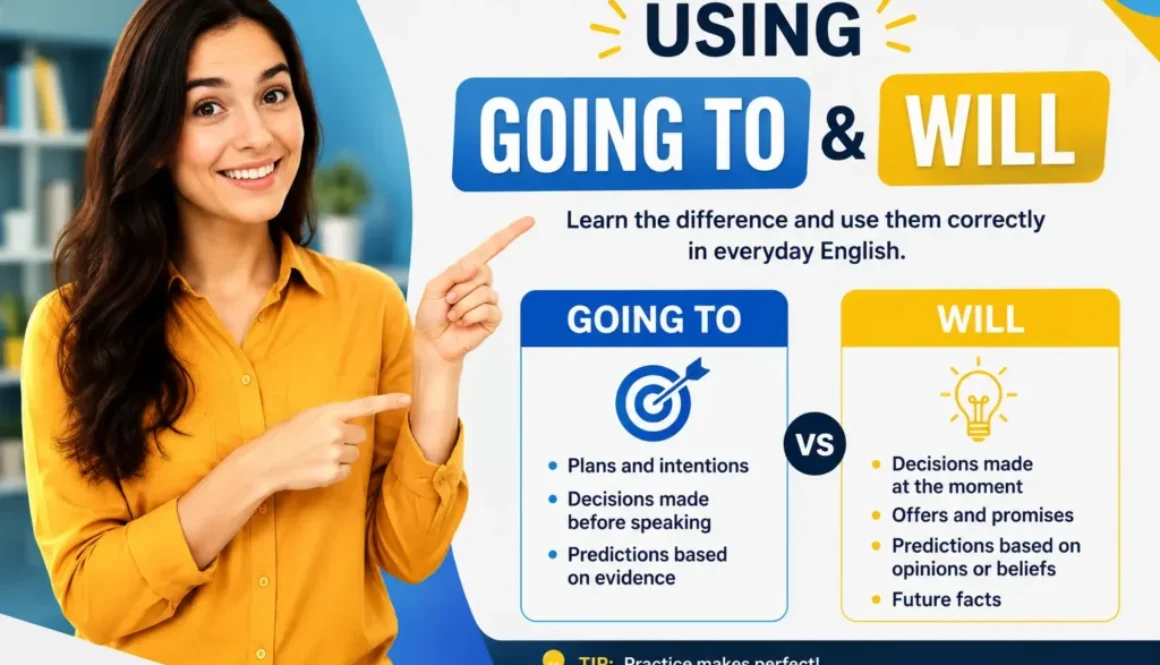
Will vs Going To: How to Use Them in English
How to Use “Will” and “Going to” in English: Complete Guide with Examples
Learning how to talk about the future is an essential part of English grammar. Two of the most common ways to talk about future actions are “will” and “be going to.” Although they can sometimes express the same idea, they are not always used in the same situations.
Many English learners ask:
- When should I use “will”?
- When should I use “going to”?
- What is the difference between “will” and “going to”?
- Can I use “will” for plans?
- Can I use “going to” for predictions?
In this complete guide, you will learn how to use will and going to correctly, with simple explanations, useful examples, common mistakes, and practical exercises.
Whether you are a beginner learning English or an intermediate student trying to improve your grammar, understanding the difference between will and going to will help you speak and write about the future more naturally.
🚀 Ready to improve your English? Start with these bookshttps://amzn.to/3TE4D7A
What Is the Difference Between “Will” and “Going to”?
Both will and be going to are commonly used to talk about the future.
However, the main difference is usually related to how the future action is decided or predicted.
We commonly use “will” for:
- Decisions made at the moment of speaking
- Offers
- Promises
- Requests
- Predictions based on opinions or beliefs
- Future facts
We commonly use “going to” for:
- Plans and intentions
- Decisions made before speaking
- Predictions based on present evidence
Compare these two sentences:
I will call you tonight.
This can mean that I am deciding to call you now.
I am going to call you tonight.
This usually means that I already have a plan or intention to call you.
The difference can be small, but understanding it will make your English more natural.
🎯 Stop guessing. Find the right books to improve your English https://amzn.to/4q5be70
How to Use “Will” in English
Will is one of the most important words used to talk about the future.
The basic structure is:
Subject + will + base verb
Examples:
- I will study tonight.
- She will call you later.
- They will arrive tomorrow.
- We will help you.
- He will come soon.
Notice that the verb after will stays in its base form.
We say:
I will go.
Not:
I will goes.
And not:
I will going.
1. Use “Will” for Decisions Made at the Moment
We often use will when we make a decision while we are speaking.
For example:
“I’m hungry.”
“I’ll make you a sandwich.”
The speaker did not necessarily plan to make a sandwich before the conversation. The decision was made at that moment.
Another example:
“The phone is ringing.”
“I’ll answer it.”
The speaker decides to answer the phone immediately.
More examples:
- I’m tired. I’ll take a break.
- It’s cold. I’ll close the window.
- You look busy. I’ll help you.
- I forgot my wallet. I’ll pay you tomorrow.
- We need more chairs. I’ll bring some.
This is one of the most important differences between will and going to.
- 🗣️ Improve your grammar, vocabulary, and speaking with the right bookshttps://amzn.to/4fKfRQs
2. Use “Will” for Promises
We also use will when we make promises.
Examples:
I will never forget you.
I will help you with your homework.
I will call you when I arrive.
I will be more careful next time.
I will finish the work tomorrow.
You can also use the short form I’ll:
I’ll help you.
I’ll call you later.
I’ll never do it again.
Promises are extremely common in everyday English, so learning this use of will is important for conversation.
3. Use “Will” for Offers
When you want to offer to do something, will is often the natural choice.
For example:
I’ll carry your bag.
I’ll help you with that.
I’ll make some coffee.
I’ll drive you home.
I’ll open the door for you.
Imagine that your friend has many bags. You can say:
Don’t worry. I’ll carry one of them.
You are offering your help at that moment.
4. Use “Will” for Predictions
We can use will when we predict something about the future based on our opinion, belief, or expectation.
Examples:
I think it will rain tomorrow.
I believe she will pass the exam.
I’m sure you will enjoy the movie.
I think he will become successful.
People will use more technology in the future.
Common expressions used with predictions include:
- I think…
- I believe…
- I’m sure…
- I expect…
- Probably…
- Maybe…
For example:
I think you will like this book.
I’m sure they will win the game.
How to Use “Going to” in English
The structure of going to is different from will.
We use:
Subject + am/is/are + going to + base verb
Examples:
- I am going to study.
- She is going to travel.
- He is going to buy a car.
- We are going to watch a movie.
- They are going to visit their family.
Remember that going to must be used with the verb be.
For example:
I am going to work.
Not:
I going to work.
1. Use “Going to” for Future Plans
We commonly use going to when we have already decided to do something.
For example:
I’m going to study English tonight.
This means I have already decided or planned to study English.
Another example:
We’re going to travel to Spain next summer.
The trip is already a plan.
More examples:
- I’m going to start a new course.
- She’s going to buy a new laptop.
- They’re going to move to another city.
- We’re going to visit our grandparents.
- He’s going to start a new job.
The important idea is:
The decision existed before the moment of speaking.
2. Use “Going to” for Predictions Based on Evidence
We can also use going to when there is clear evidence that something is about to happen.
For example, imagine you look outside and see very dark clouds.
You say:
Look at those clouds! It’s going to rain.
You are not simply giving an opinion. You have evidence: the dark clouds.
Another example:
Imagine a person is running very fast toward a wall.
You can say:
He’s going to hit the wall!
You can see the evidence.
More examples:
Look at that car! It’s going to crash.
She’s driving too fast. She’s going to have an accident.
The baby is crying. He’s going to wake everyone up.
Look at the sky. It’s going to snow.
Will vs. Going to: The Main Difference
Let’s make the difference simple.
Will = decision now
“I’m thirsty.”
I’ll get you some water.
I decided now.
Going to = plan already made
I’m going to visit my friend tomorrow.
I already have the plan.
Will = prediction based on opinion
I think Barcelona will win.
This is my opinion.
Going to = prediction based on evidence
Look at those clouds. It’s going to rain.
I have evidence.
Will vs. Going to Examples
Here are some examples to help you understand the difference.
Example 1
I’ll call Sarah tonight.
The decision may be made now.
I’m going to call Sarah tonight.
This sounds more like an existing plan.
Example 2
I think our team will win.
This is a prediction or opinion.
Look at the score! Our team is going to win.
There is evidence supporting the prediction.
Example 3
“This bag is very heavy.”
I’ll carry it for you.
This is an offer made now.
But:
I’m going to carry this bag to my office.
This is an intention or plan.
Negative Forms of “Will” and “Going to”
You can also use both forms in negative sentences.
Will not
The negative form is:
Subject + will not + base verb
The short form is:
won’t
Examples:
I won’t go there.
She won’t come tomorrow.
They won’t agree with us.
He won’t forget your birthday.
We won’t be late.
Going to – Negative
The structure is:
Subject + am/is/are + not + going to + verb
Examples:
I’m not going to buy it.
She’s not going to come tonight.
They’re not going to travel this summer.
He’s not going to study today.
We’re not going to watch that movie.
Questions with “Will”
To make questions with will, put will before the subject.
Will + subject + base verb?
Examples:
Will you come tomorrow?
Will she call me?
Will they help us?
Will he pass the exam?
Will you marry me?
Short answers:
Yes, I will.
No, I won’t.
Questions with “Going to”
For going to, move the verb be before the subject.
Am/Is/Are + subject + going to + verb?
Examples:
Are you going to study tonight?
Is she going to travel?
Are they going to buy a house?
Is he going to join us?
Are you going to watch the movie?
Short answers:
Yes, I am.
No, I’m not.
Common Mistakes with “Will” and “Going to”
English learners often make a few common mistakes.
❌ I will going to study.
✅ I will study.
You cannot use will + going to together.
❌ I going to study tonight.
✅ I am going to study tonight.
You need am/is/are before going to.
❌ She will goes tomorrow.
✅ She will go tomorrow.
After will, always use the base form of the verb.
❌ They are going to studied.
✅ They are going to study.
After going to, use the base form.
Quick Rule to Remember
When you are unsure, remember these simple questions:
Did I decide now?
Use WILL.
I’ll help you.
Did I decide before?
Use GOING TO.
I’m going to study tonight.
Is it my prediction or opinion?
Usually use WILL.
I think it will be expensive.
Can I see evidence now?
Use GOING TO.
Look at those clouds. It’s going to rain.
These rules will help you understand most everyday situations.
Final Summary: Will vs. Going to
Both will and going to are important ways to talk about the future in English.
Use will for:
- Decisions made at the moment
- Offers
- Promises
- Predictions based on opinions
- Future expectations
Use going to for:
- Plans
- Intentions
- Decisions made before speaking
- Predictions based on present evidence
The best way to learn the difference is not simply to memorize grammar rules. Practice using both forms in real situations.
For example, every morning, make a few sentences:
I’m going to study English today.
I’m going to read a book tonight.
And when you make a decision during the day:
I’ll answer the email now.
I’ll help my friend.
The more you practice, the more naturally you will choose between will and going to.
Practice: Will or Going to?
Complete the sentences with will or going to.
- Look at those clouds! It __________ rain.
- I’m thirsty. I __________ get some water.
- She has already bought a ticket. She __________ travel tomorrow.
- I think you __________ love this movie.
- Don’t worry. I __________ help you.
- We have planned everything. We __________ start tomorrow.
- Look at that child! He __________ fall.
- I promise I __________ call you later.
Answers
- is going to
- will
- is going to
- will
- will
- are going to
- is going to
- will
Conclusion
Understanding will and going to is essential if you want to improve your English grammar and speak more naturally about the future.
The difference becomes much easier when you focus on the situation rather than trying to memorize complicated grammar rules.
Remember:
WILL → decision now, offer, promise, opinion
GOING TO → plan, intention, evidence-based prediction
Start using these forms in your everyday English conversations. Make simple sentences about your plans, your predictions, and the decisions you make during the day.
The more you use will and going to, the more confident and natural your English will become.