
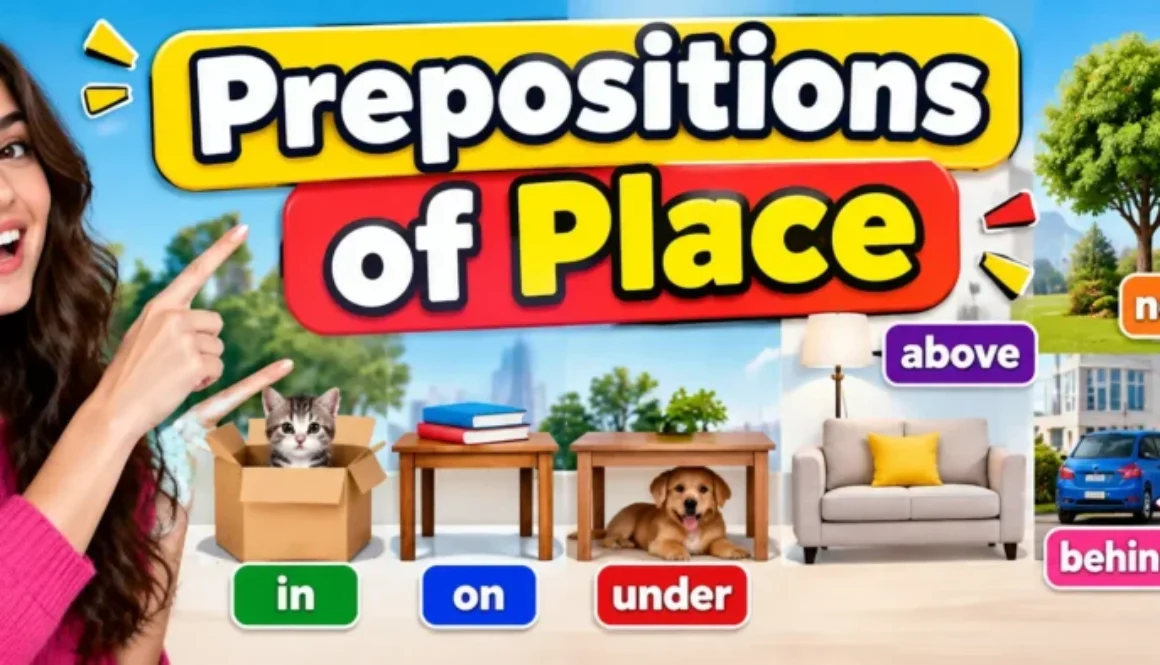
Prepositions of Place in English: Complete Guide
Prepositions of Place in English: A Complete Guide with Examples
Learning prepositions of place in English is essential for anyone who wants to speak and write English correctly. Prepositions of place help us explain where a person, animal, object, building, or place is located.
Words such as in, on, at, under, above, behind, in front of, between, next to, near, and opposite are very common in everyday English. You will hear and use them when talking about your home, school, workplace, city, neighborhood, hotel, restaurant, and many other places.
In this complete guide, you will learn the most important prepositions of place in English, how to use them correctly, and many simple examples.
What Are Prepositions of Place?
Prepositions of place are words that tell us where something or someone is located.
For example:
-
The book is on the table.
-
The children are in the classroom.
-
The car is in front of the house.
-
The supermarket is next to the bank.
-
The cat is under the chair.
In each sentence, the preposition tells us the position or location of something.
Learning prepositions of place is especially important for beginners because these words are used in many everyday conversations.
The Most Common Prepositions of Place in English
Let’s look at the most important prepositions of place and learn how to use them with simple examples.
1. IN
We use in when something is inside a place, room, container, building, or area.
Examples:
-
The students are in the classroom.
-
My keys are in my bag.
-
She is in the kitchen.
-
There is some milk in the fridge.
-
They live in Morocco.
-
He is in the car.
More examples:
The children are in the garden.
This means the children are inside the garden area.
My phone is in my pocket.
The phone is inside the pocket.
Remember:
IN = inside something
2. ON
We use on when something is touching a surface.
Examples:
-
The book is on the table.
-
Your phone is on the desk.
-
There is a picture on the wall.
-
The cup is on the shelf.
-
The keys are on the chair.
For example:
The laptop is on the table.
The laptop is touching the surface of the table.
We also use “on” for some forms of transport:
-
on the bus
-
on the train
-
on the plane
-
on a bicycle
-
on a motorcycle
Example:
I am on the bus.
3. AT
We often use at when we talk about a specific point or location.
Examples:
-
I am at the bus stop.
-
She is at school.
-
He is at work.
-
We are at the airport.
-
They are at the door.
-
He is waiting at the station.
Compare:
She is in the school.
This focuses on being inside the school building.
She is at school.
This focuses on her location or activity.
4. UNDER
Under means that something is below another thing.
Examples:
-
The cat is under the table.
-
My shoes are under the bed.
-
The ball is under the chair.
-
The children are playing under the tree.
Example:
The dog is under the table.
The dog is below the table.
5. ABOVE
Above means higher than something else.
Examples:
-
The clock is above the door.
-
The picture is above the sofa.
-
The plane is flying above the clouds.
-
There is a shelf above my desk.
Example:
The picture is above the sofa.
The picture is higher than the sofa.
6. BELOW
Below means lower than something else.
Examples:
-
The temperature is below zero.
-
The garage is below the apartment.
-
The picture is below the clock.
-
Write your name below the title.
Above vs. Below
-
The clock is above the door.
-
The shoes are below the chair.
7. BEHIND
We use behind when something is at the back of another thing.
Examples:
-
The car is behind the house.
-
The boy is hiding behind the door.
-
The garden is behind the building.
-
There is a tree behind the school.
Example:
The cat is behind the sofa.
The cat is at the back of the sofa.
8. IN FRONT OF
In front of means that something is positioned before or ahead of another thing.
Examples:
-
The car is in front of the house.
-
The teacher is standing in front of the students.
-
There is a bus stop in front of the hotel.
-
She is waiting in front of the restaurant.
Example:
The man is standing in front of the door.
He is positioned before the door.
Compare:
The car is behind the house.
The car is in front of the house.
These two expressions describe opposite positions.
9. NEXT TO
Next to means very close to or beside something.
Examples:
-
The bank is next to the supermarket.
-
I am sitting next to my friend.
-
The hotel is next to the restaurant.
-
The school is next to the park.
Example:
The pharmacy is next to the bank.
The pharmacy is directly beside the bank.
10. BESIDE
Beside has almost the same meaning as next to.
Examples:
-
She is sitting beside me.
-
The lamp is beside the bed.
-
The school is beside the park.
In everyday English, next to is very common.
11. NEAR
Near means close to something, but not necessarily directly beside it.
Examples:
-
I live near the school.
-
There is a restaurant near my house.
-
The hotel is near the airport.
-
We found a café near the station.
Compare:
The bank is next to the supermarket.
The bank is directly beside the supermarket.
The bank is near the supermarket.
The bank is close to the supermarket, but it may not be directly beside it.
12. BETWEEN
We use between when something is in the middle of two people, places, or things.
Examples:
-
The bank is between the hotel and the restaurant.
-
John is sitting between Ali and Ahmed.
-
The school is between two buildings.
-
The pharmacy is between the bank and the supermarket.
Example:
The café is between the bank and the hotel.
The café is in the middle of the bank and the hotel.
13. AMONG
We use among when something or someone is surrounded by several people or things.
Examples:
-
She was sitting among her friends.
-
The house is among the trees.
-
He was standing among the students.
Between vs. Among
Use between for two clearly separated people or things:
The school is between the bank and the hotel.
Use among when there are several people or things:
The teacher was standing among the students.
14. OPPOSITE
Opposite means directly across from something.
Examples:
-
The bank is opposite the school.
-
The hotel is opposite the restaurant.
-
There is a pharmacy opposite the supermarket.
Example:
The café is opposite the train station.
The café is on the other side, facing the train station.
15. INSIDE
Inside means in the interior of something.
Examples:
-
The children are inside the house.
-
My wallet is inside my bag.
-
There is a man inside the car.
-
Please wait inside the building.
Inside is often used when we want to emphasize that something is not outside.
16. OUTSIDE
Outside means not inside a place or building.
Examples:
-
The children are outside the house.
-
There is a car outside the hotel.
-
He is waiting outside the restaurant.
-
Please wait outside the classroom.
Compare:
The students are inside the classroom.
The students are outside the classroom.
17. CLOSE TO
Close to means near something.
Examples:
-
My house is close to the school.
-
The hotel is close to the beach.
-
The restaurant is close to the airport.
Close to and near have very similar meanings.
18. AROUND
We use around when something is surrounding another place or when something is located in different positions surrounding an area.
Examples:
-
There are many trees around the house.
-
There are restaurants around the hotel.
-
People were standing around the car.
Example:
There are several shops around the square.
The shops are located in different positions surrounding the square.
Prepositions of Place: Easy Comparison
Here is a simple way to remember the most common prepositions:
| Preposition | Meaning | Example |
|---|---|---|
| in | inside | The keys are in the bag. |
| on | touching a surface | The book is on the table. |
| at | specific location | She is at the station. |
| under | lower than | The cat is under the chair. |
| above | higher than | The clock is above the door. |
| behind | at the back | The car is behind the house. |
| in front of | before/ahead | The car is in front of the house. |
| next to | beside | The bank is next to the hotel. |
| near | close to | The school is near my house. |
| between | in the middle of two | The shop is between the bank and café. |
| among | surrounded by several | He is among his friends. |
| opposite | across from | The bank is opposite the school. |
| inside | in the interior | She is inside the house. |
| outside | not inside | He is outside the building. |
Common Mistakes with Prepositions of Place
English learners often make mistakes with prepositions of place. Here are some common examples.
Mistake 1:
❌ The book is in the table.
✅ The book is on the table.
We use on because the book is touching the surface of the table.
Mistake 2:
❌ The cat is on the room.
✅ The cat is in the room.
We use in because the cat is inside the room.
Mistake 3:
❌ The school is in front the bank.
✅ The school is in front of the bank.
Remember that the expression is:
in front of + noun
Mistake 4:
❌ The pharmacy is next the bank.
✅ The pharmacy is next to the bank.
Remember:
next to + noun
Prepositions of Place in Everyday English
Prepositions of place are extremely useful in everyday conversations.
Imagine that someone asks you:
Where is the supermarket?
You can answer:
It’s next to the bank.
Or:
It’s opposite the school.
Or:
It’s near the train station.
Or:
It’s between the hotel and the restaurant.
You can also use prepositions when giving directions:
The bank is on your left.
The hotel is in front of the restaurant.
The pharmacy is next to the supermarket.
The bus stop is opposite the school.
These expressions are useful when traveling, asking for directions, shopping, staying at a hotel, or talking about your neighborhood.
Prepositions of Place at Home
You can practice prepositions by describing your home.
For example:
The sofa is in the living room.
The TV is on the wall.
The table is in front of the sofa.
The carpet is under the table.
The lamp is next to the sofa.
The kitchen is near the living room.
This is an easy way to improve your English vocabulary and grammar at the same time.
How to Practice Prepositions of Place
The best way to learn prepositions of place is to use them in real sentences.
Look around your room and describe where things are.
For example:
-
My phone is on the desk.
-
My shoes are under the bed.
-
My bag is next to the chair.
-
The window is behind the desk.
-
The door is in front of me.
-
My books are in my bag.
Try to create at least five sentences every day.
You can also practice by looking at a picture of a room and describing everything you can see.
Final Summary
Prepositions of place are small words, but they are extremely important in English. They help us explain where people, animals, objects, buildings, and places are located.
The most important prepositions to learn are:
in, on, at, under, above, below, behind, in front of, next to, near, between, among, opposite, inside, outside, beside, close to, and around.
The key is not only to memorize these words but also to use them in real conversations.
Start by describing your bedroom, your house, your classroom, your workplace, or your neighborhood. The more you practice, the easier it will become to use English prepositions naturally and correctly.
Frequently Asked Questions About Prepositions of Place
What are prepositions of place in English?
Prepositions of place are words that describe the location or position of a person, animal, object, or place. Common examples include in, on, at, under, behind, next to, near, between, and opposite.
What is the difference between in and on?
Use in when something is inside a place or container.
The keys are in my bag.
Use on when something is touching a surface.
The keys are on the table.
What is the difference between in and at?
In usually emphasizes being inside an area or place.
She is in the classroom.
At often refers to a specific location.
She is at school.
What is the difference between next to and near?
Next to usually means directly beside something.
The bank is next to the supermarket.
Near means close to something but not necessarily directly beside it.
The bank is near the supermarket.
How can I learn prepositions of place quickly?
Practice them in real sentences. Describe the objects around you and use words such as in, on, under, behind, next to, and in front of. Regular practice will help you remember them naturally.