
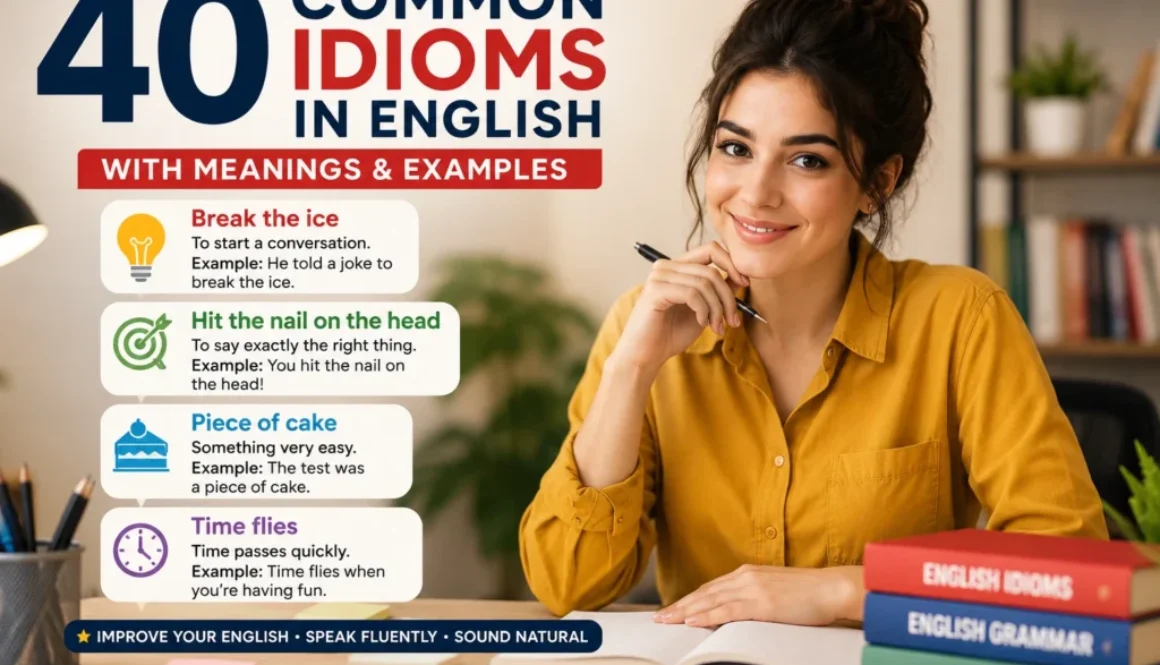
40 Common Idioms in English with Meanings and Examples for Daily Conversation
40 Common Idioms in English with Meanings and Examples
Learning common idioms in English is very important if you want to speak English naturally and fluently. Native English speakers use idioms every day in conversations, movies, TV shows, books, and social media.
In this lesson, you will learn 40 useful English idioms with meanings and examples. The explanations use simple English to help beginners understand easily.
If you want to improve your English vocabulary, English speaking, and daily conversation skills, these idioms will help you sound more natural in English.
What Is an Idiom?
An idiom is a group of words with a special meaning. The meaning is different from the literal meaning of the words.
For example:
👉 “Break the ice” does not mean breaking real ice.
It means to make people feel comfortable and start talking.
Learning idioms can help you:
- Speak English fluently
- Understand native speakers
- Improve your English vocabulary
- Sound more natural in conversations
- Improve English listening skills
1. Break the Ice
Meaning:
To start a conversation and make people feel comfortable.
Examples:
- John told a funny joke to break the ice at the meeting.
- I was nervous at the party, but Sarah broke the ice by talking to me.
- Teachers often use games to break the ice in class.
Thousands of English Learners Love These Books for learning idioms — Try Them Today! this is the link https://amzn.to/4uoINlT
2. Piece of Cake
Meaning:
Something very easy.
Examples:
- The English test was a piece of cake.
- Cooking rice is a piece of cake for my mother.
- Don’t worry about the homework. It’s a piece of cake.
3. Hit the Books
Meaning:
To study hard.
Examples:
- I have an exam tomorrow, so I need to hit the books.
- My sister hits the books every evening.
- Students usually hit the books before tests.
4. Under the Weather
Meaning:
Feeling sick.
Examples:
- I stayed home because I felt under the weather.
- Ahmed looks under the weather today.
- She was under the weather last week.
5. Once in a Blue Moon
Meaning:
Something that happens very rarely.
Examples:
- We go to the beach once in a blue moon.
- My uncle visits us once in a blue moon.
- She eats fast food once in a blue moon.
6. Spill the Beans
Meaning:
To reveal a secret.
Examples:
- Tom spilled the beans about the surprise party.
- Please don’t spill the beans.
- Someone spilled the beans before her birthday.
7. Cost an Arm and a Leg
Meaning:
Very expensive.
Examples:
- That car costs an arm and a leg.
- The hotel was beautiful, but it cost an arm and a leg.
- Smartphones can cost an arm and a leg.
8. Call It a Day
Meaning:
To stop working.
Examples:
- We worked for hours, so we decided to call it a day.
- Let’s call it a day and continue tomorrow.
- My father called it a day after fixing the car.
9. Better Late Than Never
Meaning:
It is better to do something late than not do it at all.
Examples:
- He arrived two hours late, but better late than never.
- I finally started learning English. Better late than never.
- She apologized yesterday. Better late than never.
10. A Blessing in Disguise
Meaning:
Something that seems bad at first but becomes good later.
Examples:
- Losing that job was a blessing in disguise.
- The rain was a blessing in disguise because it cooled the weather.
- Missing the bus was a blessing in disguise.
11. Burn the Midnight Oil
Meaning:
To work or study late at night.
Examples:
- She burned the midnight oil before the exam.
- I burned the midnight oil to finish the project.
- Many students burn the midnight oil during finals.
12. Bite the Bullet
Meaning:
To do something difficult or unpleasant.
Examples:
- I hate going to the dentist, but I’ll bite the bullet.
- He bit the bullet and paid the bill.
- She decided to bite the bullet and tell the truth.
13. Let the Cat Out of the Bag
Meaning:
To accidentally reveal a secret.
Examples:
- My brother let the cat out of the bag about the wedding.
- She let the cat out of the bag by mistake.
- Don’t let the cat out of the bag.
14. On Cloud Nine
Meaning:
Very happy.
Examples:
- She was on cloud nine after getting the job.
- I felt on cloud nine when I passed the exam.
- They were on cloud nine after their wedding.
15. Miss the Boat
Meaning:
To miss an opportunity.
Examples:
- I missed the boat and didn’t apply for the job.
- Hurry up or you’ll miss the boat.
- He missed the boat on investing early.
16. Pull Someone’s Leg
Meaning:
To joke with someone.
Examples:
- Are you serious or just pulling my leg?
- My friends love pulling my leg.
- I thought he was telling the truth, but he was pulling my leg.
17. Kill Two Birds with One Stone
Meaning:
To do two things at the same time.
Examples:
- I listened to English podcasts while driving to kill two birds with one stone.
- She studied and exercised at the same time.
- Walking to work helps him kill two birds with one stone.
18. The Ball Is in Your Court
Meaning:
It is your decision now.
Examples:
- I gave you my advice. Now the ball is in your court.
- The ball is in your court after the interview.
- We finished our work, so the ball is in their court.
19. Hit the Nail on the Head
Meaning:
To say exactly the right thing.
Examples:
- You hit the nail on the head with your answer.
- She hit the nail on the head when she explained the problem.
- His comment hit the nail on the head.
20. Sit on the Fence
Meaning:
To avoid making a decision.
Examples:
- Stop sitting on the fence and choose.
- He sat on the fence during the discussion.
- She always sits on the fence about politics.
21. Through Thick and Thin
Meaning:
In good times and bad times.
Examples:
- True friends stay together through thick and thin.
- My parents supported me through thick and thin.
- They loved each other through thick and thin.
22. See Eye to Eye
Meaning:
To agree with someone.
Examples:
- We see eye to eye on most issues.
- My brother and I don’t always see eye to eye.
- They finally saw eye to eye.
23. Cut Corners
Meaning:
To do something badly to save time or money.
Examples:
- Don’t cut corners on your work.
- The company cut corners to save money.
- Good builders never cut corners.
24. Add Fuel to the Fire
Meaning:
To make a bad situation worse.
Examples:
- His angry words added fuel to the fire.
- Don’t add fuel to the fire during arguments.
- She added fuel to the fire by shouting.
25. Get Cold Feet
Meaning:
To become nervous or afraid.
Examples:
- He got cold feet before the wedding.
- I got cold feet before speaking in public.
- She got cold feet and canceled the trip.
26. Jump on the Bandwagon
Meaning:
To follow a trend.
Examples:
- Many people jumped on the bandwagon.
- He jumped on the bandwagon and bought the new phone.
- Companies often jump on the bandwagon.
27. By the Skin of Your Teeth
Meaning:
Barely succeeding.
Examples:
- I passed the test by the skin of my teeth.
- They escaped by the skin of their teeth.
- He arrived on time by the skin of his teeth.
28. Go the Extra Mile
Meaning:
To make extra effort.
Examples:
- Great teachers go the extra mile.
- She went the extra mile to help me.
- Successful people usually go the extra mile.
29. Cry Over Spilled Milk
Meaning:
To be upset about something that cannot be changed.
Examples:
- Don’t cry over spilled milk.
- We made a mistake, but there’s no use crying over spilled milk.
- She cried over spilled milk for days.
30. A Fish Out of Water
Meaning:
To feel uncomfortable.
Examples:
- I felt like a fish out of water at the meeting.
- He looked like a fish out of water in the city.
- She was a fish out of water at the party.
31. Back to Square One
Meaning:
To start again from the beginning.
Examples:
- The project failed, so we are back to square one.
- I lost my work and went back to square one.
- After the mistake, they started back at square one.
32. In Hot Water
Meaning:
In trouble.
Examples:
- He is in hot water with his boss.
- She got in hot water at school.
- They are in hot water because of the mistake.
33. Keep an Eye On
Meaning:
To watch carefully.
Examples:
- Please keep an eye on my bag.
- Parents should keep an eye on their children.
- Can you keep an eye on the food?
34. A Penny for Your Thoughts
Meaning:
Asking someone what they are thinking about.
Examples:
- You look worried. A penny for your thoughts?
- My mother asked me for a penny for my thoughts.
- He smiled and said, “A penny for your thoughts?”
35. Time Flies
Meaning:
Time passes quickly.
Examples:
- Time flies when you are happy.
- We talked for hours because time flies with friends.
- Time flies during vacations.
36. The Best of Both Worlds
Meaning:
A situation where you enjoy two good things together.
Examples:
- Working online gives her the best of both worlds.
- He enjoys the best of both worlds living near the city and the beach.
- This job offers the best of both worlds.
37. Speak of the Devil
Meaning:
The person you are talking about appears suddenly.
Examples:
- Speak of the devil! Here comes Ahmed.
- We were talking about you. Speak of the devil!
- Speak of the devil, she just called me.
38. Easy Does It
Meaning:
Slow down and be careful.
Examples:
- Easy does it with that heavy box.
- Easy does it while driving.
- The doctor said, “Easy does it after surgery.”
39. No Pain, No Gain
Meaning:
You must work hard to succeed.
Examples:
- She practices every day because no pain, no gain.
- Going to the gym teaches you no pain, no gain.
- Success needs hard work. No pain, no gain.
40. Actions Speak Louder Than Words
Meaning:
What people do is more important than what they say.
Examples:
- He promised to help, but actions speak louder than words.
- Good leaders know that actions speak louder than words.
- Parents teach children that actions speak louder than words.
Final Thoughts
Learning these common English idioms can improve your English speaking, English listening, and daily conversation skills. Try to use these idioms in your daily English practice to remember them better.
The more idioms you learn, the more natural your English will sound.
Practice every day, read English stories, watch English videos, and use these expressions in real conversations.