
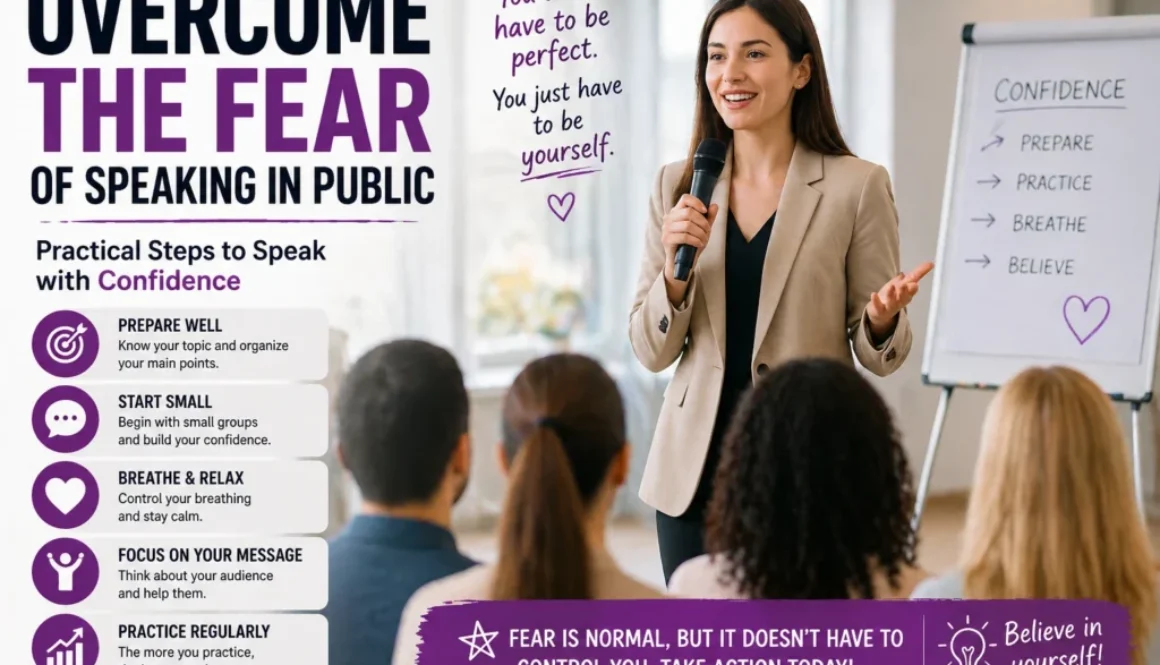
Fear of Public Speaking? Here’s How to Speak Confidently in Front of Any Audience (Full Guide + Examples)
🎤 How to Overcome the Fear of Public Speaking (Detailed Guide with Examples)
🎯 1. Start Small (Build Confidence Step by Step)
One of the biggest mistakes learners make is trying to speak in front of many people immediately. This creates pressure and increases fear. Confidence does not come suddenly—it grows slowly with practice.
You should start with small and safe situations. First, speak alone. Then speak with one person. After that, speak in a small group. Finally, you can speak in front of a larger audience.
👉 Example:
- Day 1: Speak alone in your room for 2 minutes
- Day 3: Speak with a friend for 3 minutes
- Day 7: Speak in a small group
- After 2 weeks: Try speaking in class
👉 Simple practice:
Stand in front of a mirror and say:
“I want to talk about my day. Today I woke up early. I studied English and watched a video.”
Even if it feels strange at the beginning, this method trains your brain to accept speaking.
👉 Important idea:
Confidence is like a muscle. The more you use it, the stronger it becomes.
💬 2. Use Simple English (Clarity Over Complexity)
Many learners think they need advanced vocabulary to sound intelligent. This is not true. In fact, simple English is more powerful because it is clear and easy to understand.
When you try to use difficult words, you slow down and lose confidence. But when you use simple words, you speak faster and more naturally.
👉 Example:
❌ “I would like to elaborate on this particular subject in a detailed manner.”
✅ “I want to talk about this topic.”
❌ “This situation is quite complicated and difficult to understand.”
✅ “This situation is hard.”
👉 Practice idea:
Take a complex sentence and simplify it.
👉 Key rule:
If you can say it simply, say it simply.
👉 Result:
You will feel more relaxed and your message will be clearer.
🧪 3. Practice Every Day (Consistency is the Key)
Confidence comes from repetition. The more you speak, the more natural it becomes. You don’t need a partner every day. You can practice alone and still improve a lot.
👉 Daily practice ideas:
- Talk about your day
- Describe your room
- Explain what you are doing
- Speak about your goals
👉 Example:
“This is my room. I have a desk and a chair. I study here every evening. I like this place because it is quiet.”
👉 Recording exercise:
- Record your voice
- Listen to it
- Repeat and improve
👉 Why this works:
- You hear your mistakes
- You become aware of your pronunciation
- You gain confidence in your voice
👉 Important tip:
Speak for 10–15 minutes every day. Even small practice creates big results.
🧠 4. Stop Translating in Your Head
Many learners translate from Arabic (or their native language) into English before speaking. This slows down communication and increases stress.
Instead, train your brain to think directly in English.
👉 Example:
❌ Thinking in Arabic → translating → speaking
✅ Thinking directly in English
👉 Start with simple thoughts:
- “I am tired.”
- “I am hungry.”
- “I want to learn English.”
👉 Practice technique:
Look around you and describe things in English:
- “This is a table.”
- “The door is open.”
- “The weather is hot.”
👉 Why this helps:
- You speak faster
- You reduce hesitation
- You feel more natural
👉 Key idea:
Fluency starts when you stop translating.
🎤 5. Prepare Before Speaking
Preparation gives you confidence. When you know what you want to say, your fear decreases.
Before speaking, organize your ideas.
👉 Example topic: My favorite hobby
Prepare like this:
- What is your hobby?
- Why do you like it?
- When do you do it?
👉 Then speak:
“My favorite hobby is football. I like it because it is fun and healthy. I play every weekend with my friends.”
👉 Preparation steps:
- Write key words (not full sentences)
- Practice speaking
- Repeat several times
👉 Result:
You feel ready, and your speech becomes smoother.
💡 6. Accept Mistakes (Progress Over Perfection)
Many learners stop speaking because they want to be perfect. This is a big problem.
👉 Truth:
No one speaks perfectly all the time.
Mistakes are part of learning. If you wait to be perfect, you will never speak.
👉 Example:
You say:
“He go to school yesterday”
Instead of stopping, continue speaking:
“He go to school yesterday… I mean, he went to school.”
👉 What matters:
- Communication, not perfection
- Progress, not correctness
👉 Important mindset:
Every mistake is a step forward.
🧍 7. Use Body Language (Non-Verbal Confidence)
Communication is not only about words. Your body also speaks.
Even if you feel nervous, your body can show confidence.
👉 Focus on:
- Eye contact
- Straight posture
- Natural hand movement
- Smiling
👉 Example:
Compare:
❌ Looking down, speaking softly
✅ Looking at the audience, speaking clearly
👉 Result:
People see you as confident, and you start to feel confident too.
😌 8. Control Your Breathing (Stay Calm and Focused)
When you feel nervous, your body reacts:
- Fast heartbeat
- Shaking hands
- Short breathing
👉 The solution is simple: control your breathing
👉 Exercise:
- Take a deep breath for 4 seconds
- Hold for 2 seconds
- Speak slowly
👉 Example:
Before speaking, pause and breathe. Then say:
“Today I want to talk about my experience…”
👉 Result:
- You feel calmer
- You speak more clearly
- You reduce anxiety