
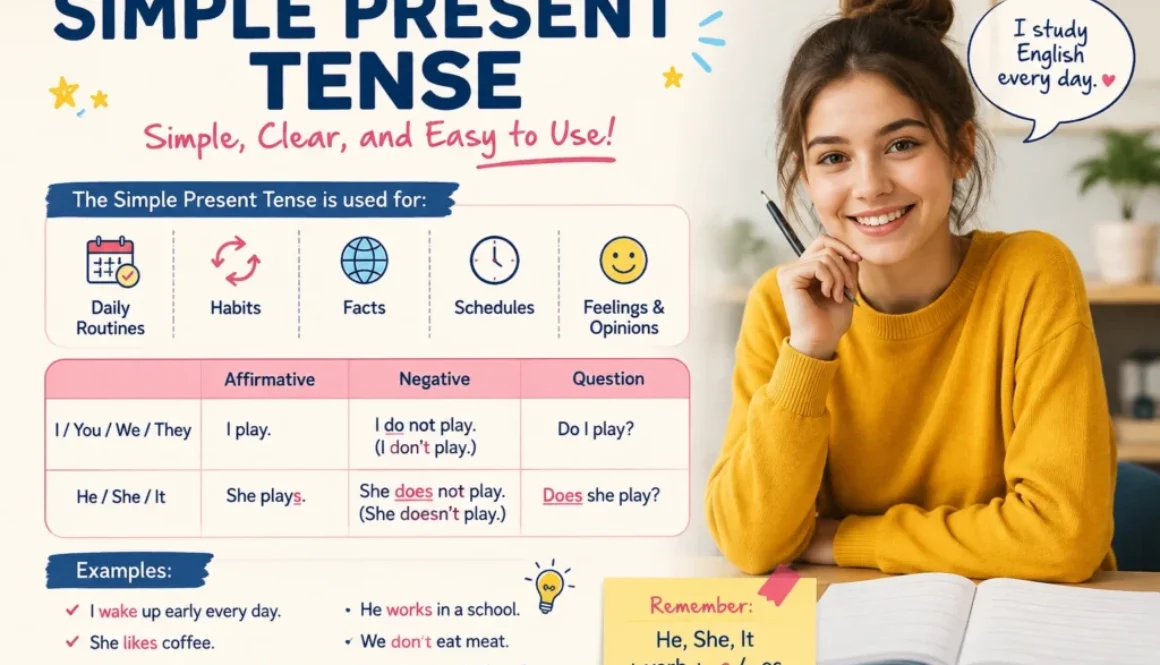
Simple Present Tense Explained with Examples: The Complete Beginner’s Guide to Using the Simple Present Tense in English Grammar
Simple Present Tense Explained with Examples: The Complete Beginner’s Guide
Learning English grammar does not have to be difficult. One of the most important grammar lessons for every English learner is the Simple Present Tense. It is the first tense that students usually learn because it is used every day in speaking, writing, reading, and listening.
If you understand the Simple Present Tense, you will be able to talk about your daily routine, habits, facts, schedules, likes, dislikes, and much more.
In this complete guide, you will learn everything you need to know about the Simple Present Tense using simple English, clear explanations, practical examples, and useful exercises.
Whether you are a beginner or want to improve your English grammar, this lesson is for you.
What Is the Simple Present Tense?
The Simple Present Tense is used to describe:
- Daily routines
- Habits
- Facts
- General truths
- Permanent situations
- Feelings
- Opinions
- Timetables and schedules
It tells us what happens regularly or what is always true.
Examples
- I study English every day.
- She drinks coffee every morning.
- They play football on Saturdays.
- The sun rises in the east.
- Water boils at 100°C.
- Birds fly.
- My father works in a hospital.
- We live in Morocco.
Notice that these actions happen regularly or are always true.
Structure of the Simple Present Tense
Positive Sentences
Subject + Base Verb
Examples
- I work.
- You work.
- We work.
- They work.
Subject + Verb + s/es
For he, she, and it, we usually add -s or -es.
Examples
- He works.
- She studies.
- It rains.
- Ahmed drives to work.
- My mother cooks dinner.
- 👨🏫 As an English teacher, I often recommend these books because they explain grammar in simple English and include plenty of practice. Check them out on Amazon. 👉 https://link.amazon/B07M0HlLS
When Do We Add “-es”?
Add -es after verbs ending in:
- ch
- sh
- ss
- x
- z
- o
Examples
| Verb | Simple Present |
|---|---|
| Watch | Watches |
| Wash | Washes |
| Go | Goes |
| Fix | Fixes |
| Pass | Passes |
📚 Looking for the best books to learn English? Discover top-rated grammar, vocabulary, speaking, and pronunciation books that can support your learning journey. 👉 [ https://link.amazon/B0gtHwWK6]
Changing “y” to “ies”
If a verb ends in consonant + y, change y to ies.
Examples
Study → Studies
Carry → Carries
Try → Tries
Cry → Cries
Negative Sentences
Use:
Subject + do not (don’t) + base verb
Examples
- I don’t like coffee.
- We don’t watch TV every day.
- They don’t play tennis.
For he, she, it
Use:
Subject + does not (doesn’t) + base verb
Examples
- He doesn’t smoke.
- She doesn’t work on Sundays.
- It doesn’t rain much here.
Notice that after doesn’t, the verb returns to its base form.
Correct:
- She doesn’t study.
Incorrect:
- She doesn’t studies.
Questions
Use:
Do + Subject + Base Verb?
Examples
- Do you like pizza?
- Do they speak English?
- Do we have homework?
- Do I need a ticket?
For he, she, and it
Does + Subject + Base Verb?
Examples
- Does she speak English?
- Does he play football?
- Does your brother work here?
- Does the train leave at six?
Short Answers
Question
Do you like tea?
Answer
Yes, I do.
No, I don’t.
Question
Does she speak French?
Answer
Yes, she does.
No, she doesn’t.
When Do We Use the Simple Present Tense?
1. Daily Routines
These are activities you do regularly.
Examples
- I wake up at 7 o’clock.
- I brush my teeth.
- I eat breakfast.
- I go to school.
- I study English every evening.
- I sleep at 11 p.m.
2. Habits
Examples
- She drinks coffee every morning.
- He exercises three times a week.
- We visit our grandparents every month.
- They read books every night.
3. Facts
Examples
- The Earth goes around the Sun.
- Water freezes at 0°C.
- Fish live in water.
- Lions eat meat.
4. Permanent Situations
Examples
- I live in Spain.
- She works in London.
- They own a restaurant.
- My parents speak Arabic.
5. Feelings
Examples
- I love music.
- She likes chocolate.
- He hates cold weather.
- We enjoy traveling.
6. Opinions
Examples
- I think English is useful.
- She believes in hard work.
- They prefer tea to coffee.
7. Schedules
Examples
- The train leaves at 9:00.
- School starts at eight.
- The movie begins at seven.
Time Expressions
The Simple Present Tense often uses these words:
- Always
- Usually
- Normally
- Often
- Sometimes
- Occasionally
- Rarely
- Seldom
- Never
- Every day
- Every week
- Every month
- Every year
- On Mondays
- At night
- In the morning
Examples
- I always study before dinner.
- She usually walks to work.
- They often travel together.
- We sometimes watch movies.
- He never arrives late.
Common Signal Words
If you see these words, the sentence often uses the Simple Present.
- Always
- Usually
- Often
- Every day
- Every week
- Sometimes
- Never
Common Verbs Used in the Simple Present
- Go
- Come
- Eat
- Drink
- Work
- Study
- Read
- Write
- Speak
- Listen
- Watch
- Play
- Cook
- Drive
- Buy
- Sell
- Need
- Want
- Love
- Like
- Hate
- Think
- Believe
- Know
- Understand
- Remember
- Forget
30 Everyday Examples
- I wake up early.
- She drinks tea.
- He studies English.
- We watch TV.
- They play football.
- My father drives to work.
- My mother cooks dinner.
- The baby sleeps well.
- Birds sing every morning.
- The sun rises in the east.
- I like pizza.
- She loves reading.
- He works in a bank.
- We speak English.
- They travel every summer.
- My sister dances beautifully.
- The dog barks loudly.
- The shop opens at nine.
- School finishes at four.
- Water boils at 100°C.
- Children enjoy cartoons.
- I clean my room every Saturday.
- My teacher explains grammar clearly.
- He washes his car every weekend.
- She writes in her diary every night.
- We learn something new every day.
- The bus arrives on time.
- My brother fixes computers.
- My grandmother grows flowers.
- I practice English every evening.
Common Mistakes
Mistake 1
❌ He play football.
✅ He plays football.
Mistake 2
❌ She don’t like tea.
✅ She doesn’t like tea.
Mistake 3
❌ Does she likes coffee?
✅ Does she like coffee?
Mistake 4
❌ I am go to school.
✅ I go to school.
Mistake 5
❌ He doesn’t works.
✅ He doesn’t work.
Practice Exercise
Complete the sentences.
- She ______ English every day.
- They ______ football on Fridays.
- Does he ______ coffee?
- My father ______ in a hospital.
- We ______ TV every evening.
- The train ______ at 8:00.
- I ______ my homework after dinner.
- He ______ not eat meat.
- ______ they live in London?
- My sister ______ books every week.
Answers
- studies
- play
- drink
- works
- watch
- leaves
- do
- does
- Do
- reads