
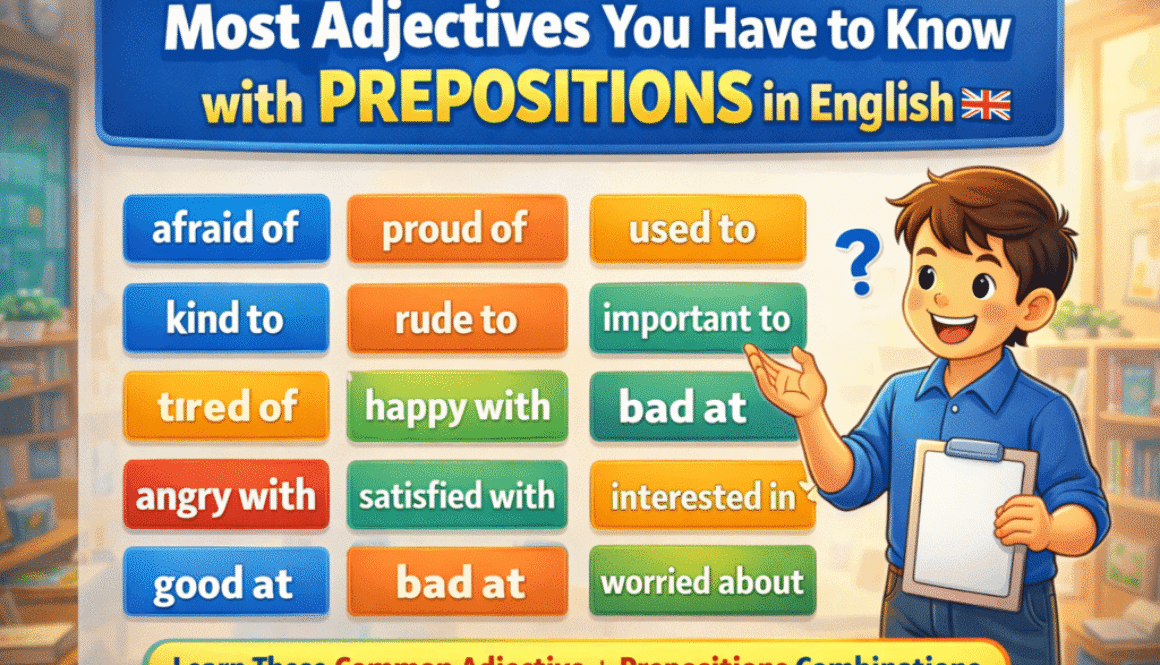
The Most Important Adjectives You Have to Know in English (Complete Guide for Learners)
Using Prepositions in English with Adjectives, Nouns, and Verbs
A Complete Guide for English Learners (With Examples)
Meta Description (SEO)
Learn how to use prepositions correctly with adjectives, nouns, and verbs in English. This complete guide includes rules, examples, and common mistakes for learners.
Introduction: Why Prepositions Are Difficult in English
Prepositions are one of the most challenging parts of English grammar. Many learners ask questions like:
-
Why do we say afraid of and not afraid from?
-
Why is it interested in but good at?
-
Why does the verb depend always take on?
The main reason is that prepositions in English do not always follow logic. Instead, they often come in fixed combinations with adjectives, nouns, and verbs. These combinations must be learned and practiced.
In this article, you will learn:
-
Prepositions used with adjectives
-
Prepositions used with nouns
-
Prepositions used with verbs
-
Common mistakes and learning tips
1. Prepositions Used with Adjectives in English
Many adjectives in English are followed by specific prepositions. These combinations are fixed and must be memorized.
1.1 Adjectives + of
We use of after adjectives that show feelings, opinions, or reactions.
Examples:
-
She is afraid of spiders.
-
He is proud of his achievements.
-
I am tired of waiting.
-
They are fond of music.
Common adjectives + of:
-
afraid of
-
proud of
-
tired of
-
ashamed of
-
aware of
1.2 Adjectives + to
We use to with adjectives that express reactions or attitudes toward people or things.
Examples:
-
She is kind to everyone.
-
He was rude to the teacher.
-
This job is important to me.
-
I am used to waking up early.
Common adjectives + to:
-
kind to
-
polite to
-
rude to
-
important to
-
accustomed to
⚠️ Note: Used to is followed by a noun or verb + -ing.
1.3 Adjectives + with
With is used when talking about relationships or emotions involving people or situations.
Examples:
-
I am happy with my results.
-
She is angry with her brother.
-
He is satisfied with the service.
Common adjectives + with:
-
happy with
-
angry with
-
pleased with
-
disappointed with
-
satisfied with
1.4 Adjectives + at / in / about
-
Good at / bad at → skills and abilities
-
Interested in → interest
-
Worried about → concern
Examples:
-
She is good at math.
-
He is interested in history.
-
I am worried about the exam.
2. Prepositions Used with Nouns in English
Many nouns are also followed by specific prepositions. These are often related to the verbs or adjectives they come from.
2.1 Nouns + of
Of is very common after nouns and is used to show possession, cause, or description.
Examples:
-
The cause of the problem is unknown.
-
He has a fear of heights.
-
She showed great pride of her work.
Common nouns + of:
-
cause of
-
reason of
-
fear of
-
advantage of
-
result of
2.2 Nouns + for
For is used to express purpose or function.
Examples:
-
There is no reason for his absence.
-
She has a talent for music.
-
This button is for emergencies.
Common nouns + for:
-
reason for
-
need for
-
demand for
-
talent for
-
respect for
2.3 Nouns + in / on / to
Examples:
-
He has experience in teaching.
-
She made progress in English.
-
The solution to the problem is simple.
-
He has access to the internet.
Common nouns:
-
experience in
-
interest in
-
solution to
-
access to
-
invitation to
3. Prepositions Used with Verbs in English
Verbs combined with prepositions are extremely important. These combinations often change the meaning of the verb.
3.1 Verb + to
Examples:
-
She listens to music every day.
-
He belongs to a club.
-
I apologized to her.
Common verbs + to:
-
listen to
-
belong to
-
talk to
-
apologize to
-
happen to
3.2 Verb + for
Examples:
-
They asked for help.
-
I paid for the meal.
-
She applied for the job.
Common verbs + for:
-
ask for
-
pay for
-
apply for
-
wait for
-
search for
3.3 Verb + on
Examples:
-
It depends on the situation.
-
You can rely on me.
-
He insisted on coming early.
Common verbs + on:
-
depend on
-
rely on
-
insist on
-
focus on
-
concentrate on
3.4 Verb + with / about
Examples:
-
He agreed with the teacher.
-
She argued with her friend.
-
We talked about the project.
4. Common Mistakes English Learners Make
❌ She is married with a doctor.
✅ She is married to a doctor.
❌ I am interested about English.
✅ I am interested in English.
❌ He depends of his parents.
✅ He depends on his parents.
5. Tips to Master Prepositions Easily
✔ Learn prepositions in phrases, not alone
✔ Use example sentences
✔ Practice with gap-fill exercises
✔ Read English texts and notice patterns
✔ Create your own sentences daily
Conclusion
Prepositions used with adjectives, nouns, and verbs are a key part of mastering English. Although they may seem confusing at first, regular exposure and practice will make them natural.
By learning these combinations step by step, you will:
-
Speak more naturally
-
Write more accurately
-
Avoid common mistakes
Keep practicing, and your English will improve faster than you expect.