👗 Long English Conversation – Shopping for Clothes (Simple Past Tense)
Sara: Hey Lina, did you go shopping last Saturday? Lina: Yes, I did! I went to the new shopping mall in the city. It was very big and modern.
Sara: Really? I wanted to go there, but I was busy. What did you buy? Lina: I bought a beautiful blue dress, a pair of jeans, and some comfortable white sneakers. They looked amazing!
Sara: That sounds great! Did you find good discounts? Lina: Yes, I found many items on sale. The jeans were 50% off, and the shoes were affordable. I also received a small gift bag from the store.
Sara: Wow, lucky you! I visited that mall last month, but I couldn’t find my size. Did you try the clothes on before buying? Lina: Of course! I tried on three dresses, but only one fit perfectly. The others were too tight.
Sara: Did you go alone, or did someone go with you? Lina: My sister came with me. She tried on a red coat, but it was too expensive, so she didn’t buy it.
Sara: What did she buy instead? Lina: She bought a stylish scarf and a brown leather handbag. She loved them!
Sara: Nice! Did you take any pictures? Lina: Yes, we took some photos in front of the fountain inside the mall. The decorations were beautiful.
Sara: Did you eat there? Lina: Yes, we stopped at a small café. We ate pizza and drank fresh orange juice. It was delicious.
Sara: Sounds like a perfect day! I stayed home, cleaned my room, and watched a movie. Nothing special. Lina: That sounds relaxing too. Do you want to go shopping with me next Friday? We can look for jackets and skirts.
Sara: I would love to! I really need new shoes and maybe a stylish skirt for my cousin’s wedding. Lina: Great! Bring your discount card and we’ll go early in the morning to avoid the crowd.
Sara: Deal! Don’t forget to take your wallet this time. Lina: Haha, don’t worry! I already put it in my bag.
Sara: Perfect. See you on Friday! Lina: See you! Take care.
Translation slows down your speaking and makes your sentences unnatural. Native speakers think directly in English, and you should train yourself to do the same.
✔ How to start thinking in English:
Start with simple words (table, door, phone, chair)
Move to short sentences (“I’m tired”, “I need to go”, “It’s cold”)
Describe things around you
Stop trying to find perfect grammar — focus on fluency
When you think in English, your speaking becomes faster and more natural.
🟦 3. Learn to Use Natural Daily Expressions
Many learners speak “textbook English,” which sounds correct but not natural. To speak fluently, you need to use real-life expressions commonly used by native speakers.
✔ Examples:
“Sounds good.”
“I’m not sure.”
“Let me check.”
“I’ll think about it.”
“It’s up to you.”
Learning common phrases improves fluency much faster than memorizing long grammar rules.
🟦 4. Use the Shadowing Technique (Most Powerful Method)
Shadowing is a technique where you listen to English audio and speak at the same time as the speaker. You copy their tone, pronunciation, speed, and rhythm.
✔ Steps:
Choose a YouTube video, podcast, or series clip.
Play 5–10 seconds.
Repeat EXACTLY as the speaker speaks.
Continue with the next part.
Shadowing helps:
Improve pronunciation
Sound more natural
Learn real speaking rhythm
Remove your native accent gradually
Even 10 minutes per day is extremely effective.
🟦 5. Surround Yourself With English (Immersion Method)
To speak English fluently, you must live with the language, even if you live in a non-English-speaking country.
✔ Do these every day:
Change your phone language to English
Watch movies with English subtitles
Listen to English music
Follow English pages and YouTubers
Read English posts, news, and comments
The more English you hear and see, the more fluent you become.
🟦 6. Learn Pronunciation, Not Just Vocabulary
Many learners know hundreds of words but cannot use them correctly because they pronounce them wrongly. Pronunciation is the heart of speaking.
✔ Focus on:
word stress
sentence stress
intonation
linking words
silent letters
Example words learners mispronounce:
Comfortable → /ˈkʌmf.tə.bəl/
Chocolate → /ˈtʃɒk.lət/
Wednesday → /ˈwenz.deɪ/
Correct pronunciation makes your speaking clearer and more natural.
🟦 7. Use English Speaking Apps and AI (Modern Learning Method)
We now live in a digital world where technology can help you practice anytime.
✔ Useful tools:
English conversation apps
Speaking coaches
AI practice partners
Pronunciation analyzers
Online conversation rooms
These tools allow you to practice speaking without fear or pressure.
🟦 8. Learn English Through Listening (The Natural Way)
Speaking improves faster when listening improves. Babies learn to speak by listening first, not studying grammar.
✔ Listen to:
Podcasts
Audiobooks
Movies
TV shows
YouTube videos
Interviews
Choose content that matches your level. Listening builds vocabulary, pronunciation, intonation, and natural expressions.
🟦 9. Practice Real Conversations (Online or Offline)
Speaking to real people is the strongest way to improve fluency. You don’t need native speakers — even speaking to non-native speakers helps a lot.
✔ Where to find partners:
Online English groups
Language exchange apps
Global speaking communities
Social media English clubs
WhatsApp or Telegram English groups
Regular conversation builds confidence and reduces fear.
🟦 10. Use Role-Play Situations Daily
Role-play helps you practice real-life English situations before you face them.
✔ Example scenarios:
Ordering food
Asking for directions
Making a phone call
Booking a hotel
Job interview
Going to the doctor
By repeating these, you train your brain to speak automatically in real situations.
🟦 11. Stop Focusing on Grammar While Speaking
Grammar is important, but focusing too much on it while speaking makes you slow, nervous, and unsure.
✔ Instead:
Learn grammar through examples
Use simple sentences
Correct your mistakes after speaking, not during speaking
Practice speaking freely
Fluent speakers make mistakes — fluency is more important while speaking.
🟦 12. Build Your Confidence Through Small Wins
Confidence is one of the biggest problems learners face. Even advanced learners feel shy sometimes.
✔ How to increase confidence:
Speak 5 minutes every day
Celebrate progress
Record yourself and notice improvement
Use simple sentences
Don’t worry about mistakes
Focus on communication, not perfection
The more confident you feel, the faster you improve.
🟦 13. Use Short, Simple Sentences (Natural Speaking)
Native speakers rarely use long, complicated sentences. Natural English is simple.
✔ Example:
❌ “I would like to inform you that I am unable to attend the meeting today.” ✔ “Sorry, I can’t make it to the meeting today.”
Simple English = Clear English.
🟦 14. Learn Phrasal Verbs and Daily Idioms
These expressions make you sound fluent and natural.
✔ Examples:
“Figure out”
“Run out of”
“Pick up”
“Look forward to”
“Break down”
Daily idioms:
“Piece of cake”
“Hit the books”
“Under the weather”
Using these in conversation boosts your speaking level instantly.
🟦 15. Practice Speaking in Front of a Mirror
This method helps you:
Improve body language
Develop confidence
Practice pronunciation
Reduce hesitation
Speak for 3–5 minutes daily in front of a mirror about anything you want.
🟦 16. Read Out Loud Every Day
Reading out loud is one of the fastest ways to improve pronunciation and fluency.
✔ Try reading:
Articles
Stories
Dialogues
Quotes
Focus on clarity, speed, and correct pronunciation.
🟦 17. Set Clear Speaking Goals
Goals help you stay consistent.
✔ Examples:
“I will speak English 10 minutes every morning.”
“I will learn 5 new expressions every day.”
“I will watch 1 English video daily.”
Small goals = big progress.
🟦 Conclusion: The Road to Natural, Confident English Speaking
Improving your English speaking skills requires consistency, exposure, and confidence. You don’t need perfect grammar or an American accent — you just need to practice the right way.
To speak English fluently:
Speak every day
Think in English
Use natural expressions
Shadow native speakers
Listen daily
Practice real conversations
Build confidence
Use simple language
If you follow these methods consistently, your improvement will be fast, natural, and noticeable. Speaking English fluently is not difficult; it just requires daily habits and the right techniques.
50 Most Used English Sentences in Our Daily Life (With Easy Examples)
Learning daily English sentences is the fastest way to improve speaking skills. These expressions are used naturally by native speakers at home, school, work, and in everyday situations like shopping or asking for help. In this lesson, you’ll find 50 simple, useful English sentences that you can use immediately in daily conversations.
🌟 Basic English Conversation for Beginners | محادثة إنجليزية طويلة للمبتدئين
📌 Learn Daily English Conversation for Beginners with Arabic Translation | تعلم محادثة إنجليزية يومية للمبتدئين مع الترجمة العربية
🗣️ Introduction | مقدمة
Learning to speak English starts with simple daily conversations. In this post, you’ll read a long beginner-level English conversation, translated into Arabic to help you understand every word. It’s perfect for daily practice and for building vocabulary and confidence.
تعلم التحدث بالإنجليزية يبدأ بالمحادثات اليومية البسيطة. في هذا المقال، ستقرأ محادثة إنجليزية طويلة للمبتدئين، مترجمة إلى العربية لتساعدك على فهم كل كلمة. إنها مثالية للتدريب اليومي وبناء المفردات والثقة.
🧑🤝🧑 English Conversation at the Supermarket | محادثة إنجليزية في السوبر ماركت
Sarah and Ali are shopping in the supermarket.
💬 Sarah: Hello, Ali! How are you today? مرحبًا يا علي! كيف حالك اليوم؟
💬 Ali: Hi, Sarah. I’m fine, thank you. And you? مرحبًا يا سارة. أنا بخير، شكرًا. وأنتِ؟
💬 Sarah: I’m good too. I need to buy some fruits and vegetables. أنا أيضًا بخير. أحتاج أن أشتري بعض الفواكه والخضروات.
💬 Ali: That’s great. I also need milk, bread, and eggs. هذا رائع. أنا أيضًا أحتاج إلى الحليب والخبز والبيض.
💬 Sarah: Let’s start with the fruits. Do you like bananas? لنبدأ بالفواكه. هل تحب الموز؟
💬 Ali: Yes, I do. Bananas are my favorite fruit. نعم، أحبها. الموز هو فاكهتي المفضلة.
💬 Sarah: How about apples and oranges? ماذا عن التفاح والبرتقال؟
💬 Ali: I like apples, but I don’t like oranges. أنا أحب التفاح، لكن لا أحب البرتقال.
💬 Sarah: OK. I will take two apples and one banana. حسنًا. سأشتري تفاحتين وموزة واحدة.
💬 Ali: I will take some milk now. Where is the milk section? سأشتري بعض الحليب الآن. أين قسم الحليب؟
💬 Sarah: It’s near the bread. Let’s go there together. إنه بجانب الخبز. لنذهب هناك معًا.
💬 Ali: Great. I also want some eggs. رائع. أريد أيضًا بعض البيض.
💬 Sarah: Do you cook at home? هل تطبخ في المنزل؟
💬 Ali: Yes, I cook dinner every day. نعم، أطبخ العشاء كل يوم.
💬 Sarah: That’s impressive! I only cook on weekends. هذا مثير للإعجاب! أنا أطبخ فقط في عطلة نهاية الأسبوع.
💬 Ali: Let’s go to the cashier. I think we’re done. لنذهب إلى المحاسب. أعتقد أننا انتهينا.
💬 Sarah: Yes. Let’s pay and go home. نعم. هيا ندفع ونعود إلى المنزل.
🛒 Long Grocery Store Conversation with Arabic Translation (Sentence by Sentence)
👨🦱 Customer: Good morning! الزبون: صباح الخير! ☀️
👩💼 Shopkeeper: Good morning! How can I help you today? البائعة: صباح النور! كيف يمكنني مساعدتك اليوم؟
👨🦱 Customer: I’m looking for some fresh fruits. How much are the bananas? الزبون: أبحث عن بعض الفواكه الطازجة. بكم الموز؟ 🍌
👩💼 Shopkeeper: Bananas are $1.20 per kilo today. البائعة: الموز بدولار وعشرين سنتًا للكيلو اليوم.
👨🦱 Customer: That’s a good price. How about the apples? الزبون: هذا سعر جيد. وماذا عن التفاح؟ 🍎
👩💼 Shopkeeper: Apples are $3 per bag. They’re very sweet. البائعة: التفاح بـ 3 دولارات للكيس. طعمه حلو جداً.
👨🦱 Customer: Do you have any grapes? الزبون: هل عندك عنب؟ 🍇
👩💼 Shopkeeper: Yes, red grapes are $4 per kilo, and green grapes are $3.50. البائعة: نعم، العنب الأحمر بـ 4 دولارات للكيلو، والعنب الأخضر بـ 3.50 دولارات.
👨🦱 Customer: That seems a bit expensive. Are they fresh? الزبون: يبدو غاليًا بعض الشيء. هل هو طازج؟ 🧐
👩💼 Shopkeeper: Yes, they were delivered this morning. البائعة: نعم، تم توصيله هذا الصباح.
👨🦱 Customer: How much is this big watermelon? الزبون: بكم هذه البطيخة الكبيرة؟ 🍉
👩💼 Shopkeeper: It’s $6 for the whole watermelon. البائعة: 6 دولارات للبطيخة كاملة.
👨🦱 Customer: And the tomatoes? Are they on sale? الزبون: وماذا عن الطماطم؟ هل عليها عرض؟ 🍅
👩💼 Shopkeeper: Yes, tomatoes are only $1.50 per kilo today. البائعة: نعم، الطماطم فقط بـ 1.50 دولار للكيلو اليوم.
👨🦱 Customer: Great! I’ll take 2 kilos of tomatoes and 1 kilo of cucumbers. الزبون: رائع! سأخذ 2 كيلو من الطماطم و1 كيلو من الخيار. 🥒
👩💼 Shopkeeper: Sure! That’s $3 for the tomatoes and $1.80 for the cucumbers. البائعة: بالتأكيد! هذا 3 دولارات للطماطم و1.80 دولار للخيار.
👨🦱 Customer: Do you sell olive oil? الزبون: هل تبيعون زيت الزيتون؟ 🫒
👩💼 Shopkeeper: Yes, we have different types. This bottle is $10, and the small one is $6. البائعة: نعم، لدينا أنواع مختلفة. هذه الزجاجة بـ 10 دولارات، والصغيرة بـ 6 دولارات.
👨🦱 Customer: I’ll take the small one. Can I see some cheese? الزبون: سأخذ الصغيرة. هل يمكنني رؤية الجبن؟ 🧀
👩💼 Shopkeeper: Of course. This is goat cheese – $5 per piece. البائعة: طبعًا. هذا جبن الماعز – بـ 5 دولارات للقطعة.
👨🦱 Customer: Do you have any cheaper options? الزبون: هل لديكم خيارات أرخص؟ 💵
👩💼 Shopkeeper: Yes, this local cheese is $3.50 and still very good. البائعة: نعم، هذا الجبن المحلي بـ 3.50 دولارات وجودته ممتازة.
👨🦱 Customer: How much is everything? الزبون: كم المجموع؟ 🧾
👩💼 Shopkeeper: Let me check… The total is $25.30. البائعة: دعني أتحقق… المجموع 25.30 دولارًا.
👨🦱 Customer: Do you accept credit cards? الزبون: هل تقبلون الدفع بالبطاقة؟ 💳
👩💼 Shopkeeper: Yes, we accept cash, credit, and mobile payments. البائعة: نعم، نقبل النقد والبطاقات والدفع عبر الهاتف. 📱
👨🦱 Customer: Thank you very much! الزبون: شكراً جزيلاً! 😊
👩💼 Shopkeeper: You’re welcome! Have a great day! البائعة: على الرحب والسعة! أتمنى لك يوماً سعيداً! 🌟
🧠 Grocery Store Vocabulary List (English – Arabic + Emojis)
📘 Learn English in Easy Steps – A Simple Guide for Beginners
📌 Introduction
Learning English is a big goal for many people. It helps you travel, work, study, and connect with the world. But sometimes it feels hard or confusing. Don’t worry! You can learn English in easy steps.
This guide is for beginners who want to start learning English in a simple, clear, and smart way.
✅ Step 1: Start with the Basics
Learn the alphabet, numbers, and common words. Practice saying and writing simple things like:
Hello, how are you?
My name is…
I am 20 years old.
💡 Tip: Use apps like Duolingo or Memrise to begin.
✅ Step 2: Learn 5–10 New Words Daily
Start building your vocabulary. Write the words, say them aloud, and use them in your own sentences.
📌 Example:
apple
run
happy
book
school
💡 Tip: Use flashcards or a vocabulary notebook.
✅ Step 3: Practice Listening Every Day
Listen to English sounds every day. Try:
Short podcasts 🎧
English songs 🎵
Children’s cartoons 🎬
YouTube lessons 📱
Even if you don’t understand everything, listening helps your brain get used to English.
✅ Step 4: Speak Without Fear
Start speaking English as soon as possible. Talk to yourself in the mirror, or speak with friends and teachers.
📌 Example: You: What do you like? Friend: I like football!
💡 Tip: Mistakes are normal. Keep speaking!
✅ Step 5: Read Simple Texts
Begin reading easy English texts:
Short stories
Blogs for beginners
Children’s books
📌 Example sentence: “She goes to the park. She plays with her dog.” Reading helps you see correct grammar and new words.
✅ Step 6: Write Every Day
Write short things every day:
A sentence about your day
A small paragraph about your family
A list of your favorite food
📌 Example: “Today I go to the market. I buy bread and milk. I feel happy.”
💡 Tip: Writing helps you remember words better.
✅ Step 7: Use Technology to Learn
Try using English learning apps, games, websites, and videos.
✅ Recommended:
BBC Learning English
Quizlet
Hello English
British Council Kids
Learning becomes more fun with technology!
✅ Step 8: Review and Repeat
Always review what you learn. Repeating is very important.
💡 Tip: Make a review schedule. For example:
Monday: Learn new words
Tuesday: Review Monday’s words + new ones
✅ Step 9: Use English in Real Life
Try to use English in your day:
Change your phone language
Think in English
Watch English shows with subtitles
Talk to English-speaking friends
✅ Step 10: Stay Positive and Keep Going
Learning a new language is a journey. Some days are easy, others are hard — and that’s okay! Be patient. Be proud of your small progress.
You don’t need to be perfect. You just need to start, practice, and keep going. With these 10 simple steps, learning English becomes easier and more fun!
📘 50 Irregular Verbs in the Simple Past with Arabic Translation
٥٠ فعلًا غير منتظم في الماضي مع الترجمة والأمثلة
🔤 What Are Irregular Verbs? | تعريف الأفعال غير المنتظمة
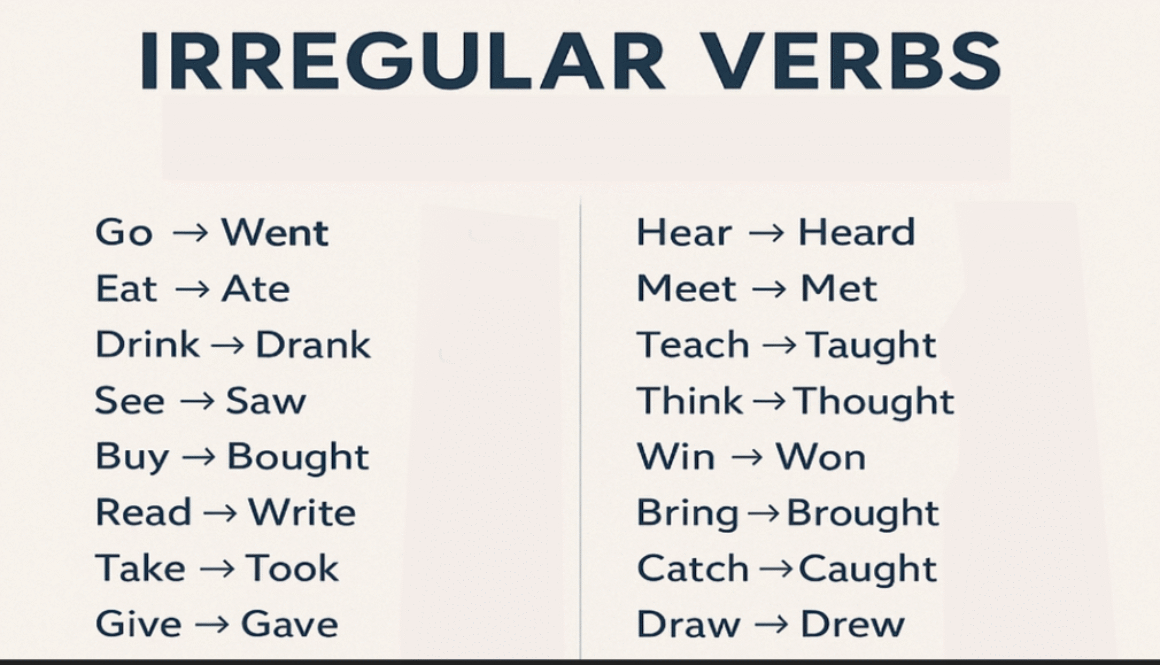
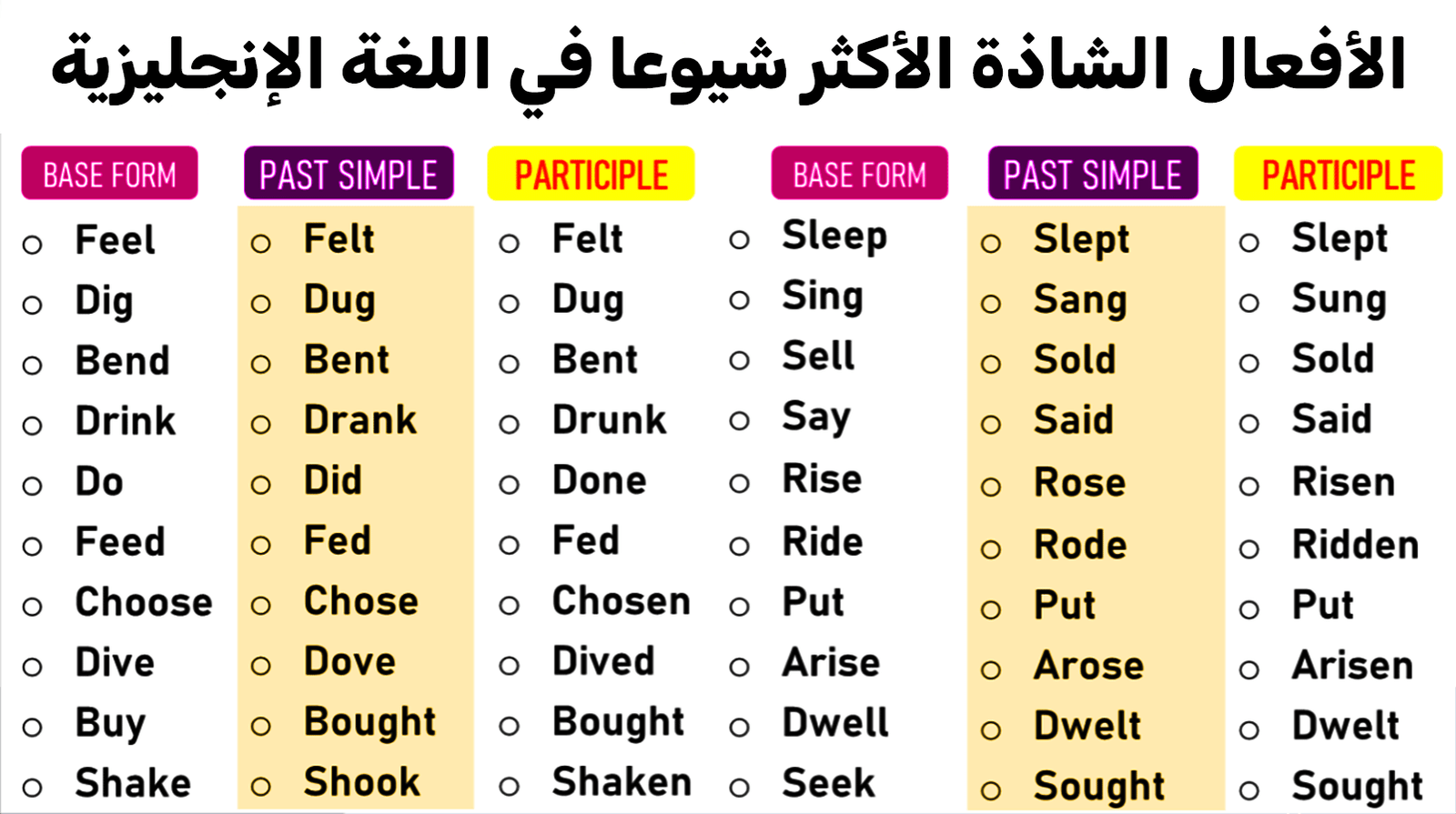
English Definition of irregular verbs : Irregular verbs are common English verbs that do not follow the regular -ed pattern when used in the simple past tense or past participle. These verbs are important in daily English conversations, grammar lessons, and English speaking practice. Examples include go → went, eat → ate, and see → saw. Learning irregular verbs helps you speak and write English correctly.
1. Go → Went
ذهب Sentence: I went to the market. ذهبت إلى السوق.
2. Eat → Ate
أكل Sentence: She ate lunch at noon. أكلت الغداء عند الظهر.
3. Drink → Drank
شرب Sentence: He drank orange juice. شرب عصير البرتقال.
4. See → Saw
رأى Sentence: We saw a rainbow. رأينا قوس قزح.
5. Buy → Bought
اشترى Sentence: I bought a new phone. اشتريت هاتفًا جديدًا.
6. Read → Read (same spelling, different pronunciation)
قرأ Sentence: He read the newspaper. قرأ الصحيفة.
7. Write → Wrote
كتب Sentence: She wrote a story. كتبت قصة.
8. Take → Took
أخذ Sentence: He took my book. أخذ كتابي.
9. Give → Gave
أعطى Sentence: She gave me a gift. أعطتني هدية.
10. Sleep → Slept
نام Sentence: He slept all day. نام طوال اليوم.
11. Begin → Began
بدأ Sentence: The class began at 8. بدأ الدرس الساعة ٨.
12. Run → Ran
ركض Sentence: She ran to school. ركضت إلى المدرسة.
13. Come → Came
جاء Sentence: He came home late. جاء إلى المنزل متأخرًا.
14. Have → Had
كان لديه Sentence: I had breakfast early. تناولت الفطور مبكرًا.
15. Say → Said
قال Sentence: She said hello. قالت مرحبًا.
16. Make → Made
صنع Sentence: He made a cake. صنع كعكة.
17. Stand → Stood
وقف Sentence: They stood in a line. وقفوا في صف.
18. Find → Found
وجد Sentence: She found her wallet. وجدت محفظتها.
19. Leave → Left
غادر Sentence: He left the house. غادر المنزل.
20. Feel → Felt
شعر Sentence: I felt tired. شعرت بالتعب.
21. Hear → Heard
سمع Sentence: She heard a noise. سمعت صوتًا.
22. Meet → Met
قابل Sentence: I met my old friend. قابلت صديقي القديم.
23. Teach → Taught
درّس Sentence: He taught us math. درّس لنا الرياضيات.
24. Think → Thought
فكّر Sentence: I thought about you. فكرت بك.
25. Win → Won
فاز Sentence: They won the game. فازوا بالمباراة.
26. Bring → Brought
أحضر Sentence: She brought her lunch. أحضرت غداءها.
27. Catch → Caught
أمسك Sentence: He caught the ball. أمسك الكرة.
28. Draw → Drew
رسم Sentence: She drew a flower. رسمت زهرة.
29. Drive → Drove
قاد Sentence: I drove to work. قدت إلى العمل.
30. Fall → Fell
سقط Sentence: He fell on the stairs. سقط على الدرج.
31. Fly → Flew
طار Sentence: The bird flew away. طار الطائر بعيدًا.
32. Grow → Grew
نمى Sentence: The plant grew fast. نمت النبتة بسرعة.
33. Know → Knew
عرف Sentence: I knew the answer. عرفت الجواب.
34. Lie → Lay
استلقى Sentence: He lay on the sofa. استلقى على الأريكة.
35. Lose → Lost
فقد Sentence: She lost her phone. فقدت هاتفها.
36. Ride → Rode
ركب Sentence: He rode a bicycle. ركب دراجة.
37. Say → Said
قال Sentence: She said goodbye. قالت وداعًا.
38. Sell → Sold
باع Sentence: They sold their car. باعوا سيارتهم.
39. Send → Sent
أرسل Sentence: I sent an email. أرسلت بريدًا إلكترونيًا.
40. Sit → Sat
جلس Sentence: He sat on the chair. جلس على الكرسي.
41. Speak → Spoke
تحدث Sentence: I spoke to the manager. تحدثت إلى المدير.
42. Steal → Stole
سرق Sentence: Someone stole my bike. سرق أحدهم دراجتي.
43. Swim → Swam
سبح Sentence: She swam in the pool. سبحت في المسبح.
44. Tell → Told
أخبر Sentence: He told me a story. أخبرني بقصة.
45. Think → Thought
فكر Sentence: I thought it was easy. ظننت أنه سهل.
46. Understand → Understood
فهم Sentence: She understood the lesson. فهمت الدرس.
47. Wake → Woke
استيقظ Sentence: I woke up at 6. استيقظت الساعة 6.
48. Wear → Wore
لبس Sentence: He wore a jacket. لبس سترة.
49. Win → Won
فاز Sentence: She won the race. فازت في السباق.
50. Break → Broke
كسر Sentence: He broke the window. كسر النافذة.
👩🦰 Sara and 👨🦱 Adam – Talking About Their Weekend
Sara: Hi Adam! How was your weekend? مرحبًا آدم! كيف كانت عطلتك الأسبوعية؟
Adam: It was great! I went to the beach. كانت رائعة! ذهبت إلى الشاطئ.
Sara: Wow! Did you swim there? رائع! هل سبحت هناك؟
Adam: Yes, I swam for two hours. Then I ate lunch with my friends. نعم، سبحت لمدة ساعتين. ثم أكلت الغداء مع أصدقائي.
Sara: That sounds fun. I stayed home and read a new book. يبدو ممتعًا. بقيت في المنزل وقرأت كتابًا جديدًا.
Adam: Nice! What book did you read? جميل! ما هو الكتاب الذي قرأتِه؟
Sara: It was a story about a boy who found a treasure. كانت قصة عن ولد وجد كنزًا.
Adam: Interesting! I also took many photos at the beach. مثير للاهتمام! التقطت أيضًا العديد من الصور على الشاطئ.
Sara: Did you bring your camera? هل أحضرتَ الكاميرا الخاصة بك؟
Adam: Yes, I brought it with me. And I met some new people too. نعم، أحضرتها معي. وقابلت بعض الأشخاص الجدد أيضًا.
Sara: That’s awesome! I wrote in my journal about my weekend. رائع! كتبت في مذكرتي عن عطلتي الأسبوعية.
Adam: Great! Maybe next time we can go out together. رائع! ربما في المرة القادمة يمكننا الخروج معًا.