
Present Continuous Tense Explained with Easy Examples
Master the Present Continuous in 15 Minutes: The Ultimate Beginner’s Guide
Learning English grammar can feel challenging, especially when you are just starting. However, some grammar topics are easier than you think. One of the most useful tenses in English is the Present Continuous Tense. It is used every day by native speakers to describe actions happening right now, temporary situations, and future plans.
In this complete guide, you will learn everything about the Present Continuous Tense in simple English. We will explain the rules, sentence structure, spelling changes, common mistakes, signal words, examples, exercises, and tips to help you master this tense in just 15 minutes.
By the end of this lesson, you will feel more confident using the Present Continuous Tense in your conversations, writing, and English exams.
🎯 Stop wasting time on random resources. Discover the English books that can help you build confidence in grammar, vocabulary, speaking, and writing. https://amzn.to/454mM0Q
What Is the Present Continuous Tense?
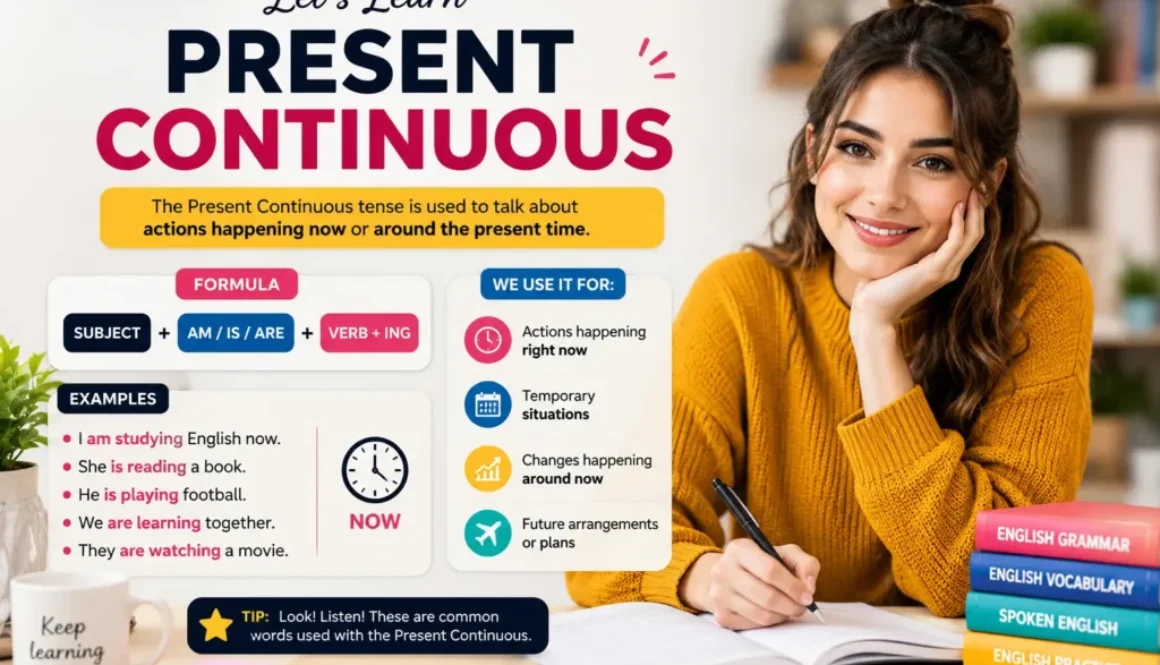
The Present Continuous Tense (also called the Present Progressive Tense) describes an action that is happening now or around the present time.
Examples
- I am reading a book.
- She is cooking dinner.
- They are playing football.
- We are learning English.
- The baby is sleeping.
These actions are happening at this moment.
Structure of the Present Continuous Tense
The structure is very simple.
Positive Sentences
Subject + am / is / are + verb + ing
Examples
- I am studying English.
- You are reading a book.
- He is driving to work.
- She is watching TV.
- It is raining.
- We are having lunch.
- They are playing basketball.
Negative Sentences
Subject + am / is / are + not + verb + ing
Examples
- I am not sleeping.
- She isn’t working today.
- He isn’t watching TV.
- We aren’t waiting.
- They aren’t studying.
Questions
Am / Is / Are + Subject + verb + ing?
Examples
- Are you studying?
- Is she cooking?
- Is he driving?
- Are they playing football?
- Am I speaking too fast?
When Do We Use the Present Continuous Tense?
1. Actions Happening Right Now
Use the Present Continuous for actions happening at this exact moment.
Examples
- I am writing an email.
- She is talking on the phone.
- They are watching a movie.
- We are having breakfast.
- The teacher is explaining the lesson.
2. Temporary Situations
Use it for situations that are temporary.
Examples
- I am living with my uncle this month.
- She is working in Madrid for six months.
- We are staying in a hotel.
- He is learning Spanish this year.
3. Changes Happening Around Now
Examples
- Technology is changing quickly.
- The weather is getting warmer.
- My English is improving.
- Prices are increasing every year.
4. Future Arrangements
The Present Continuous is also used for planned future events.
Examples
- I am meeting my friend tomorrow.
- We are flying to London next week.
- She is visiting her parents this weekend.
- They are starting a new job on Monday.
🎯 Stop wasting time on random resources. Discover the English books that can help you build confidence in grammar, vocabulary, speaking, and writing. https://amzn.to/4xks04w
5. Repeated Annoying Actions
Often used with always, constantly, or continually.
Examples
- He is always losing his keys.
- She is always talking during class.
- They are constantly arguing.
- My phone is always ringing.
Time Expressions
The Present Continuous often uses these expressions.
- Now
- Right now
- At the moment
- Currently
- Today
- This week
- This month
- Nowadays
- Look!
- Listen!
Examples
- I am studying now.
- She is working at the moment.
- Look! The dog is running.
- Listen! Someone is singing.
Spelling Rules for Adding “-ing”
Most verbs
Add -ing
- Work → Working
- Read → Reading
- Play → Playing
Verbs Ending in “e”
Remove e, then add -ing
- Write → Writing
- Make → Making
- Drive → Driving
- Come → Coming
Short Vowel + Consonant
Double the last letter.
- Sit → Sitting
- Run → Running
- Swim → Swimming
- Stop → Stopping
- Get → Getting
Verbs Ending in “ie”
Change ie to y.
- Lie → Lying
- Die → Dying
- Tie → Tying
Positive Examples
- I am drinking coffee.
- She is reading a novel.
- He is driving home.
- We are learning English.
- They are watching TV.
- My brother is studying.
- The children are playing outside.
- It is snowing.
- The teacher is speaking.
- I am cleaning my room.
- She is washing the dishes.
- We are waiting for the bus.
- They are working together.
- The baby is crying.
- My parents are cooking dinner.
- He is using his laptop.
- We are taking notes.
- The birds are singing.
- She is wearing a blue dress.
- I am listening to music.
Negative Examples
- I am not sleeping.
- She isn’t driving.
- He isn’t eating.
- They aren’t studying.
- We aren’t working.
- The children aren’t playing.
- It isn’t raining.
- She isn’t talking.
- He isn’t listening.
- I am not watching TV.
Question Examples
- Are you studying?
- Is she cooking?
- Is he working?
- Are they playing?
- Are we leaving now?
- Is the baby sleeping?
- Are you listening?
- Is your teacher speaking?
- Are the children running?
- Is it raining?
WH-Questions
- What are you doing?
- Where are you going?
- Why are you laughing?
- Who are you talking to?
- When are you leaving?
- How are you feeling?
- Which book are you reading?
- What is she cooking?
- Why is he crying?
- Where are they staying?
Present Continuous vs Simple Present
| Simple Present | Present Continuous |
|---|---|
| I work every day. | I am working now. |
| She reads books. | She is reading a book. |
| They play football every weekend. | They are playing football now. |
| We study English every day. | We are studying English at the moment. |
| He drives to work. | He is driving to work now. |
Common Mistakes
Incorrect
❌ I am study English.
✅ I am studying English.
❌ She is cook dinner.
✅ She is cooking dinner.
❌ They playing football.
✅ They are playing football.
❌ He are working.
✅ He is working.
❌ We is learning English.
✅ We are learning English.
Practice Exercise
Complete the sentences.
- She ______ (read) a book.
- I ______ (study) English now.
- They ______ (play) football.
- He ______ (drive) to work.
- We ______ (watch) a movie.
- The baby ______ (sleep).
- My father ______ (cook).
- It ______ (rain).
- The children ______ (run).
- You ______ (learn) English.
Answers
- is reading
- am studying
- are playing
- is driving
- are watching
- is sleeping
- is cooking
- is raining
- are running
- are learning
Tips to Master the Present Continuous
- Practice speaking every day.
- Describe what people around you are doing.
- Watch English videos and repeat the sentences.
- Learn common action verbs.
- Write five Present Continuous sentences every day.
- Use time expressions like now and at the moment.
- Read simple English stories.
- Listen to English conversations.
Frequently Asked Questions
What is the Present Continuous Tense?
It is an English tense used to describe actions happening now, temporary situations, and future arrangements.
What is the formula?
Subject + am/is/are + verb + ing
When do we use the Present Continuous?
- Actions happening now
- Temporary actions
- Future plans
- Changing situations
- Repeated annoying actions
What are common signal words?
- Now
- Right now
- At the moment
- Today
- Currently
- Look!
- Listen!
Conclusion
The Present Continuous Tense is one of the most important grammar structures in English. It helps you describe actions happening right now, talk about temporary situations, discuss future arrangements, and express changes happening around you.
The more you practice using the Present Continuous in your daily conversations, writing, and reading, the more natural it will become. Try describing what you and the people around you are doing every day. With regular practice, you’ll soon be using this tense confidently in real-life situations.