
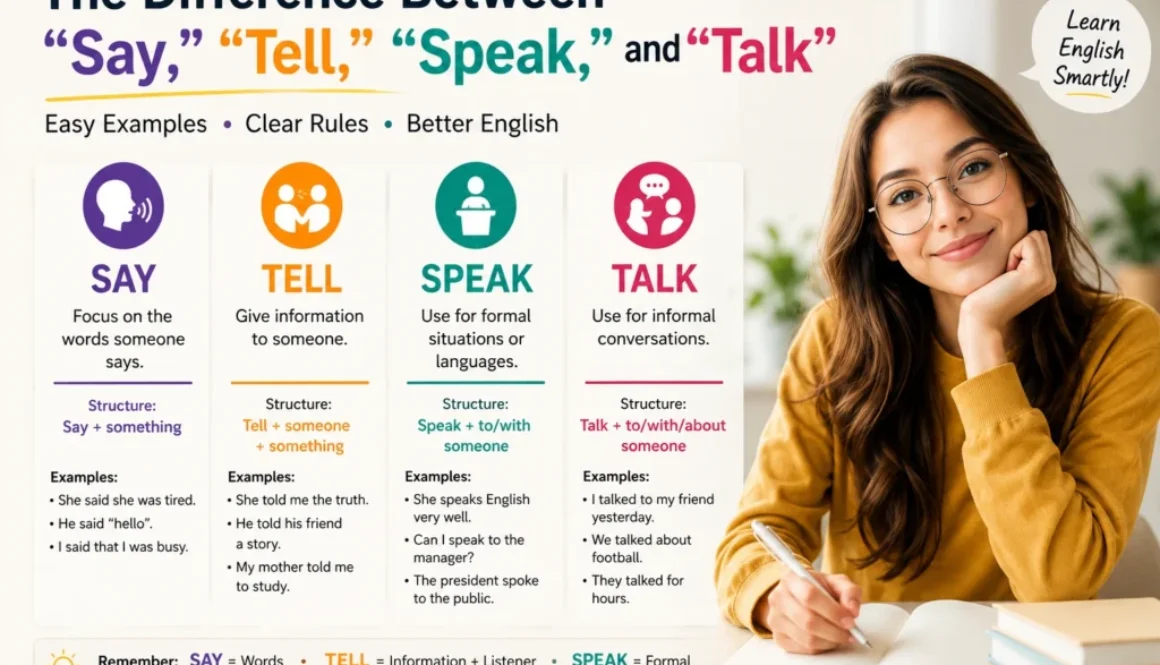
The Difference Between Say, Tell, Speak, and Talk in English with Examples
The Difference Between “Say,” “Tell,” “Speak,” and “Talk” in English
Easy English Grammar Lesson with Simple Explanations and Many Examples
Learning English grammar can sometimes feel difficult, especially when words have similar meanings. Many English learners get confused about the verbs say, tell, speak, and talk because all of them are connected to communication.
However, these four verbs are used in different ways in English grammar and conversation. If you use the wrong one, your sentence may sound unnatural or incorrect.
The good news is that this lesson will make everything easy to understand.
In this detailed English grammar guide, you will learn:
- The meaning of say, tell, speak, and talk
- The difference between these verbs
- Grammar rules
- Common mistakes
- Simple explanations
- Real-life examples
- Daily English sentences
- Practice exercises
This lesson is perfect for:
- Intermediate English learners
- ESL students
- English speaking practice
- IELTS and TOEFL learners
- Anyone who wants to speak English fluently
Why Is This Grammar Topic Important?
Native English speakers use these verbs every day in:
- Daily conversations
- English speaking
- Movies and TV shows
- Business English
- School and work communication
If you learn how to use these verbs correctly, you will:
✅ Speak English more naturally
✅ Improve your grammar
✅ Understand native speakers better
✅ Avoid common English mistakes
✅ Sound more confident in conversations
1. How to Use “Say” in English
The verb say focuses on the words someone speaks.
Usually, after say, we mention the information or words directly.
Structure:
Say + something
Examples:
- She said she was tired.
- He said “good morning.”
- I said that I was hungry.
- My teacher said the homework was important.
- They said they would arrive tomorrow.
“Say” Usually Does NOT Need a Person
❌ Incorrect:
- She said me hello.
- He said me the answer.
✅ Correct:
- She said hello to me.
- He said the answer to me.
This is one of the most common mistakes in English grammar.
More Examples of “Say”
Daily English Sentences:
- My mother said dinner was ready.
- Tom said he loves football.
- Sarah said she wants to travel.
- The doctor said I should rest.
- My friend said the movie was amazing.
Questions with “Say”
- What did she say?
- Why did he say that?
- Did they say anything about the meeting?
Common Expressions with “Say”
Say hello
- I said hello to my neighbor.
Say goodbye
- She said goodbye before leaving.
Say thank you
- Don’t forget to say thank you.
Say sorry
- He said sorry for being late.
Say something
- Please say something!
Direct Speech and Indirect Speech with “Say”
Direct Speech:
- She said, “I am happy.”
Indirect Speech:
- She said that she was happy.
More Examples:
- He said, “I love English.”
- He said that he loved English.
2. How to Use “Tell” in English
The verb tell focuses on giving information to another person.
Usually, tell needs a listener.
Structure:
Tell + someone + something
Examples:
- She told me the truth.
- He told us a story.
- My teacher told the students to study.
- I told my friend about the problem.
- They told us the news yesterday.
Important Rule About “Tell”
After tell, we usually mention the person.
❌ Incorrect:
- She told that she was tired.
- He told a joke. (possible but less complete)
✅ Correct:
- She told me that she was tired.
- He told us a joke.
Common Expressions with “Tell”
Tell the truth
- Always tell the truth.
Tell a lie
- The boy told a lie.
Tell a story
- My grandmother told us a beautiful story.
Tell a secret
- Don’t tell anyone my secret.
Tell the time
- Can you tell the time?
Tell the difference
- I cannot tell the difference between these colors.
More Examples of “Tell”
Daily English Sentences:
- She told me to wait outside.
- My father told me to work hard.
- They told us about the accident.
- He told his wife everything.
- I told my teacher the truth.
Questions with “Tell”
- Can you tell me your name?
- Did she tell you the answer?
- Why didn’t he tell us?
Difference Between “Say” and “Tell”
This is one of the biggest grammar problems for English learners.
Let’s make it simple.
SAY
👉 Focus on words
TELL
👉 Focus on information + listener
Compare These Sentences
SAY
- She said she was tired.
- He said “hello.”
- They said the test was difficult.
TELL
- She told me she was tired.
- He told me hello.
- They told us the test was difficult.
Easy Trick to Remember
SAY = words
TELL = someone
More Comparison Examples
| Say | Tell |
|---|---|
| He said he was busy. | He told me he was busy. |
| She said “thank you.” | She told me thank you. |
| They said the food was delicious. | They told us the food was delicious. |
| I said nothing. | I told my friend everything. |
3. How to Use “Speak” in English
The verb speak is more formal.
We use speak when talking about:
- Languages
- Formal conversations
- Professional communication
Structure of “Speak”
Speak + language
Speak to/with someone
Speak about something
Examples of “Speak”
Languages
- She speaks English fluently.
- Do you speak Arabic?
- I want to speak French.
Formal Communication
- May I speak to the manager?
- The president spoke to the public.
- Our teacher spoke about grammar.
Professional Situations
- I need to speak with my boss.
- The doctor spoke to the patient.
- She spoke at the conference.
More Daily Examples of “Speak”
- He speaks very fast.
- We spoke about the project.
- They spoke for two hours.
- Can I speak to you privately?
- She doesn’t speak much in class.
Common Expressions with “Speak”
Speak English
- I want to speak English confidently.
Speak loudly
- Please speak loudly.
Speak softly
- The nurse spoke softly to the child.
Speak clearly
- Can you speak clearly?
4. How to Use “Talk” in English
The verb talk is more informal and relaxed.
We use talk for casual conversations with friends, family, or people we know well.
Structure of “Talk”
Talk to someone
Talk with someone
Talk about something
Examples of “Talk”
- We talked for hours.
- I talked to my friend yesterday.
- They talked about football.
- She likes talking with her classmates.
- Let’s talk about your future.
More Daily Examples of “Talk”
- My parents talked all night.
- He talks too much.
- We talked on the phone yesterday.
- Stop talking during class.
- They talked about their vacation.
Common Expressions with “Talk”
Talk about
- We talked about movies.
Talk to
- I need to talk to you.
Talk with
- She talked with her teacher.
Small talk
- We made small talk before the meeting.
Difference Between “Speak” and “Talk”
Both words are similar, but there is a small difference.
SPEAK
👉 More formal
TALK
👉 More informal
Compare These Examples
| Speak | Talk |
|---|---|
| I need to speak with the manager. | I want to talk with my friend. |
| The president spoke on TV. | We talked after dinner. |
| She speaks English well. | They talked about sports. |
| May I speak to you? | Can we talk? |
Native English Usage
In everyday English, native speakers sometimes use speak and talk in similar ways.
Example:
- I spoke with my teacher.
- I talked with my teacher.
Both are correct.
However:
- “speak” sounds more formal
- “talk” sounds more casual
Common English Mistakes
Mistake 1
❌ She said me the truth.
✅ She told me the truth.
Mistake 2
❌ He told that he was tired.
✅ He said that he was tired.
Mistake 3
❌ I say English very well.
✅ I speak English very well.
Mistake 4
❌ We spoke about football all night with friends.
✅ We talked about football all night with friends.
Real-Life Conversation Examples
Example 1
At School
- Teacher: “Did you tell your parents about the meeting?”
- Student: “Yes, I told them yesterday.”
Example 2
At Work
- Boss: “Can I speak to you for a minute?”
- Employee: “Of course.”
Example 3
Friends Talking
- Anna: “What did he say?”
- Lisa: “He said he was busy.”
Example 4
Family Conversation
- Mother: “Why didn’t you tell me?”
- Son: “I was afraid.”
Practice Exercises
Choose the correct answer.
1.
She _____ me the truth yesterday.
- said
- told
✅ Answer: told
2.
He _____ he was sick.
- said
- told
✅ Answer: said
3.
Can you _____ English?
- talk
- speak
✅ Answer: speak
4.
We _____ about our future plans.
- talked
- spoke
✅ Answer: talked
5.
My teacher _____ us to study harder.
- said
- told
✅ Answer: told
Final Tips to Remember
SAY
👉 Focus on words
TELL
👉 Usually needs a person
SPEAK
👉 Formal communication and languages
TALK
👉 Informal conversation
Final Thoughts
The verbs say, tell, speak, and talk are very important in English grammar and daily conversation. Many learners confuse these words, but with practice, they become easy to use.
Remember:
- Read English stories
- Listen to English conversations
- Practice speaking every day
- Write your own example sentences
The more you practice English, the more natural your speaking will become.
Keep learning and never stop practicing English!