
Simple Present Tense in English — Full Grammar Lesson with Clear Examples
Simple Present Tense in English — Full Grammar Lesson with Clear Examples
📌 Introduction: What Is the Simple Present Tense?
The Simple Present Tense is one of the most important tenses in English. We use it to talk about daily routines, facts, general truths, and repeated actions. This tense is very common in conversations, exams, business English, and everyday communication. Understanding it will help learners speak and write English more confidently.
In this lesson, you will learn when and how to use the simple present, spelling rules, signal words, and more than 50 examples to help your students or readers understand easily.
📘 When Do We Use the Simple Present Tense?
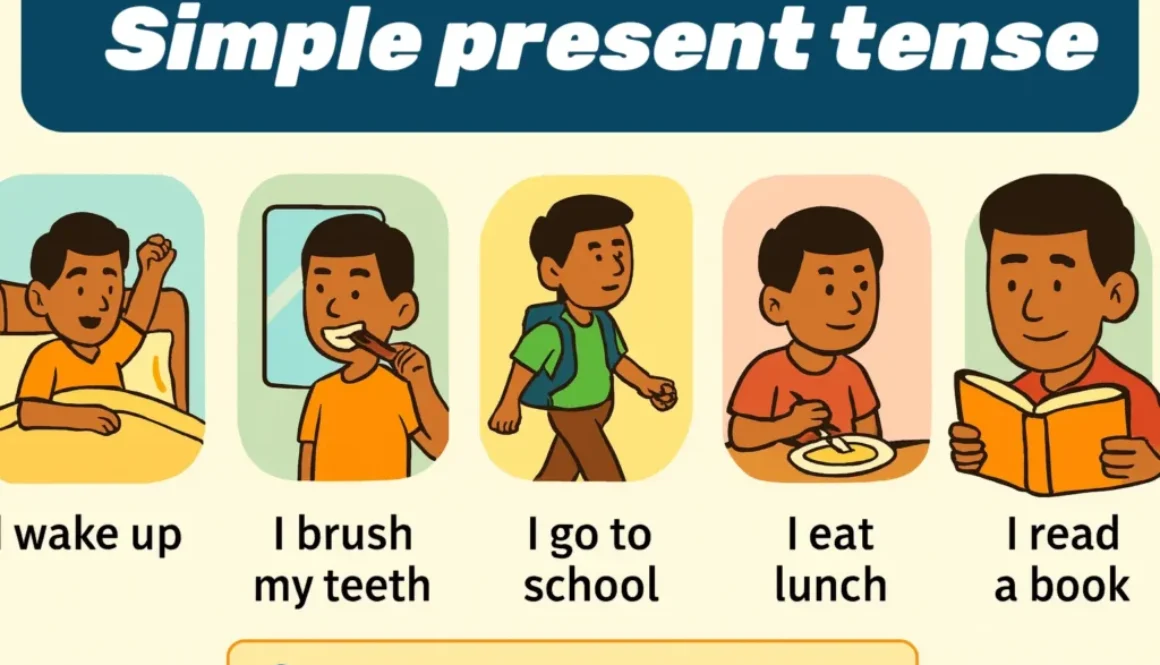
1️⃣ For Daily Routines & Habits
We use the simple present to talk about things we do every day or regularly.
Examples:
I wake up at 7 a.m.
She drinks coffee every morning.
They go to school by bus.
2️⃣ For Facts & General Truths
These are things that are always true.
Examples:
The sun rises in the east.
Water boils at 100°C.
Birds fly.
3️⃣ For Permanent Situations
Things that stay the same for a long time.
Examples:
He lives in London.
My father works in a bank.
4️⃣ For Timetables & Schedules
We use it with fixed events (transport, lessons, programs).
Examples:
The train leaves at 6:30.
School starts at 8:00.
5️⃣ For Feelings, Opinions & Thoughts
Some verbs are usually used in the simple present.
Examples:
I like chocolate.
She believes in hard work.
We need more time.
📝 How Do We Form the Simple Present Tense?
✔ Affirmative Form
| Subject | Verb |
|---|---|
| I / You / We / They | base form → play, eat, go |
| He / She / It | add -s / -es → plays, eats, goes |
Examples:
He plays football.
They eat lunch at school.
She goes to work early.
✔ Negative Form
Use do not (don’t) or does not (doesn’t) + base verb.
Examples:
I don’t like tea.
She doesn’t go to the gym.
They don’t watch TV at night.
✔ Question Form (Yes/No Questions)
Use Do/Does + subject + base verb?
Examples:
Do you speak English?
Does he play piano?
Do they work on weekends?
✔ WH- Questions (What, Where, When…?)
Examples:
Where do you live?
What does she want?
When do they study?
📚 Spelling Rules for Adding “-s” or “-es”
1️⃣ Add –s for most verbs:
play → plays
read → reads
**2️⃣ Add –es for verbs ending in:
ch → watch → watches
sh → wash → washes
ss → kiss → kisses
x → fix → fixes
o → go → goes
3️⃣ Verbs ending in consonant + y:
change y → i + es
study → studies
try → tries
💡 Signal Words for the Simple Present
These words show we usually use the simple present:
always
usually
often
sometimes
never
every day / week / month
on Mondays
in the morning
Example:
She always wakes up early.
They sometimes play tennis.
✨ 20 Useful Simple Present Examples
I work from home.
She studies English every evening.
They play football on Sundays.
My brother watches cartoons.
The store opens at 9 a.m.
We visit my grandparents every Friday.
He cooks dinner for the family.
The bus arrives at 7:45.
They speak three languages.
She walks to school.
I don’t eat fast food.
He doesn’t drive to work.
Do you like music?
Does she read books?
Where do they live?
When do classes start?
The earth moves around the sun.
My cat sleeps all day.
We need more water.
She teaches math.