2. What Are “Do” and “Does”?
Do and does are auxiliary verbs (helping verbs). They help us form:
They do NOT show action. The action is always in the main verb.
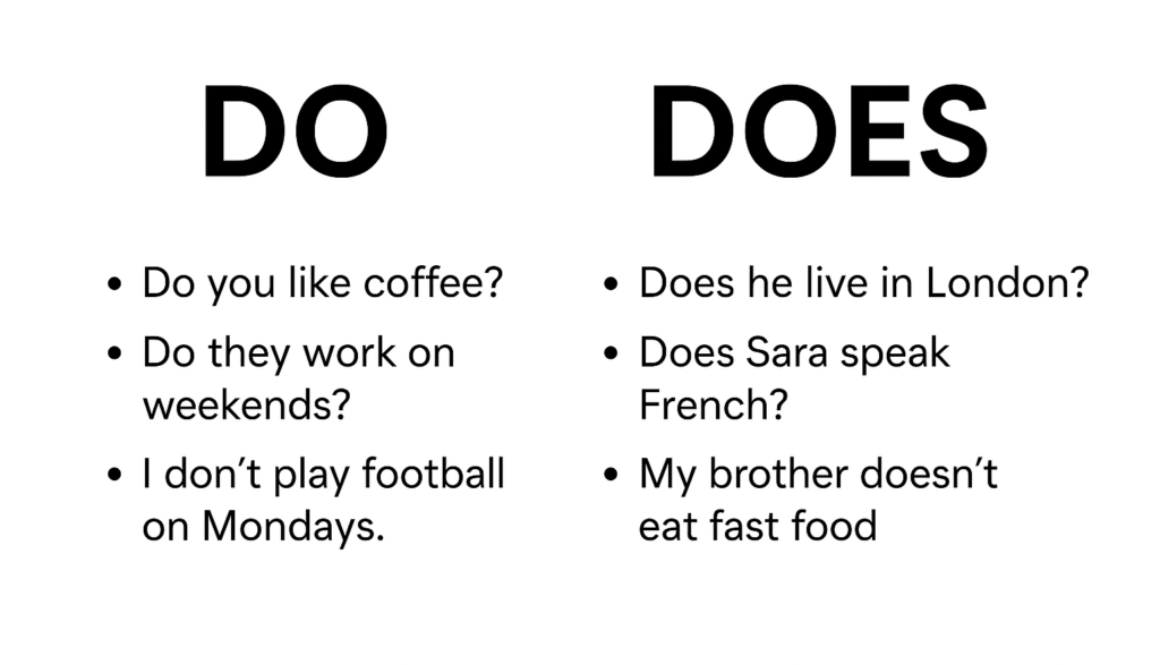
✔️ DO → plural subjects + “I” and ”you”
✔️ DOES → singular subjects (he, she, it)
3. When to Use “Do”
We use do with:
This is one of the most important grammar rules in English.
✔️ Examples in Affirmative Sentences:
I do my homework every afternoon.
You do amazing work.
We do exercises in the morning.
They do their best to study English.
These sentences show action, not the auxiliary use.
4. When to Use “Does”
We use does with:
✔️ Examples in Affirmative Sentences:
He does his homework after dinner.
She does her hair every morning.
It does a good job cleaning the floor.
Again, these show action.
5. Do vs Does in Questions
In questions, do and does become auxiliary verbs. They move to the beginning of the sentence.
Structure:
Do/Does + subject + base verb + ?
5.1 Questions with DO
Use DO with: I, you, we, they
✔️ Examples:
5.2 Questions with DOES
Use DOES with: he, she, it
✔️ Examples:
⚠️ Important Rule:
The main verb must be in the base form.
❌ Wrong: Does he likes football?
✔️ Correct: Does he like football?
6. Do vs Does in Negative Sentences
To make negative sentences, we use:
do not (don’t)
does not (doesn’t)
Structure:
Subject + do/does + not + base verb
6.1 Negative Sentences with DO
Use DO NOT / DON’T with: I, you, we, they
✔️ Examples:
I do not (don’t) understand the question.
You don’t need to hurry.
We don’t watch TV at night.
They don’t like spicy food.
6.2 Negative Sentences with DOES
Use DOES NOT / DOESN’T with: he, she, it
✔️ Examples:
⚠️ Rule Reminder:
After doesn’t, the verb always returns to the base form.
❌ Wrong: She doesn’t likes pizza.
✔️ Correct: She doesn’t like pizza.
7. Short Answers (Yes/No)
Short answers are common in daily English.
7.1 Do – Short Answers
Do you like tea?
Do they work on Sundays?
Yes, they do.
No, they don’t.
7.2 Does – Short Answers
Does he speak Arabic?
Yes, he does.
No, he doesn’t.
Does she live near here?
Yes, she does.
No, she doesn’t.
8. Common Mistakes (Very Important Section for SEO)
8.1 Adding “s” to the main verb after DOES
❌ Wrong: Does she likes coffee?
✔️ Correct: Does she like coffee?
This is the most common mistake English learners make.
8.2 Using DO with He/She/It
❌ Wrong: Do he play football?
✔️ Correct: Does he play football?
8.3 Using DOES with I/You/We/They
❌ Wrong: Does you understand?
✔️ Correct: Do you understand?
8.4 Forgetting DO/DOES in questions
❌ Wrong: Where she work?
✔️ Correct: Where does she work?
8.5 Using “–s” on the verb in negative sentences
❌ Wrong: She doesn’t likes apples.
✔️ Correct: She doesn’t like apples.
9. Daily Life Examples Using Do and Does
This section helps your learners understand real-life usage. Use it for SEO with keywords like daily English sentences, English grammar examples, and simple present.
9.1 Home & Family Life
I do the laundry on Saturdays.
She does the cleaning in the morning.
They do the cooking together.
He does the shopping once a week.
9.2 School & Work Life
You do excellent work on your projects.
She does a great job teaching children.
They do their homework after school.
He does his reports late at night.
9.3 Daily Questions We Ask
9.4 Negative Daily Examples
I don’t eat breakfast early.
They don’t drive to work.
He doesn’t like noisy places.
She doesn’t watch TV at night.
10. Do vs Does in WH-Questions
When using WH-words (what, where, when, why, how), we still use do or does.
Structure:
Wh-word + do/does + subject + base verb + ?
✔️ Examples with DO:
✔️ Examples with DOES:
Where does he work?
Why does she wake up early?
When does it start raining?
What does he want to eat?
11. Advanced Tips for Sounding Natural
11.1 Use contractions in daily speech
This makes you sound more natural and fluent.
11.2 Stress “do” or “does” for emphasis
This adds emotion or strong meaning.
11.3 Remember: the main verb always stays base
This rule never changes in questions and negatives.
12. Conclusion
Mastering do vs does is essential for anyone learning English, especially in the present simple tense. Knowing when to use each one helps you form correct questions, negatives, and natural-sounding sentences.
In this article, you learned:
When to use do
When to use does
How to make questions
How to make negatives
Short answers
Common mistakes
Daily-life examples
WH-questions