30 Common English Mistakes Intermediate Students Make (With Easy Corrections)
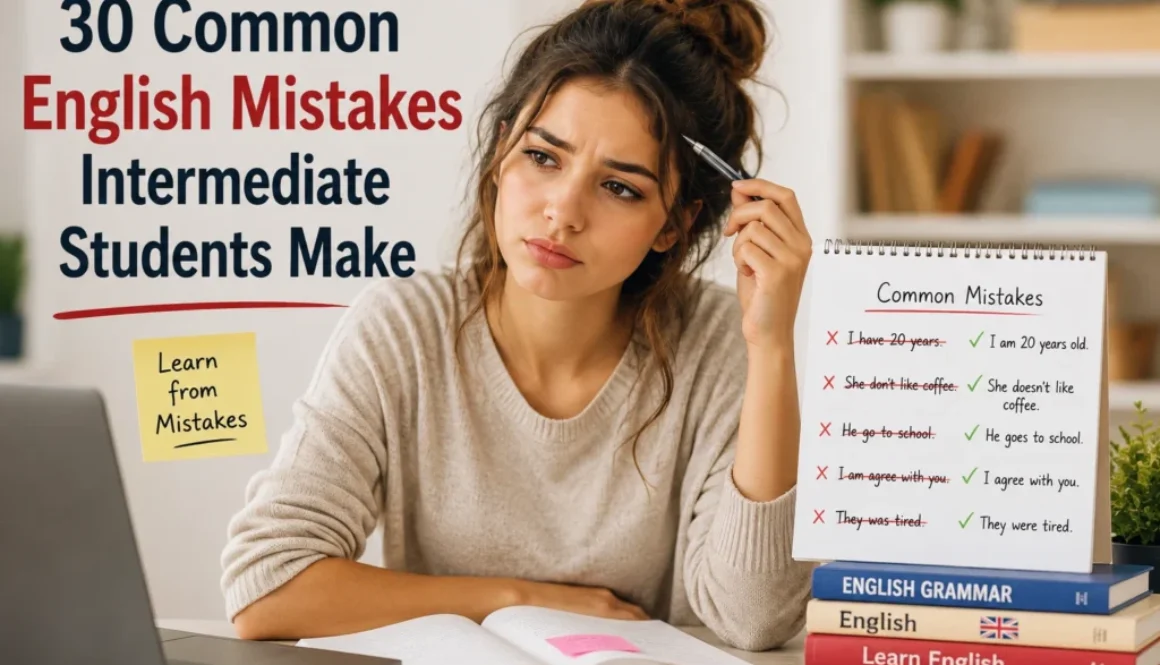
30 Common English Mistakes Intermediate Students Make
Learning English is exciting, but many intermediate English learners make common mistakes in grammar, vocabulary, pronunciation, and sentence structure. The good news is that these mistakes are normal, and you can improve quickly when you understand the correct forms.
In this lesson, you will learn 30 common English mistakes intermediate students make, along with easy explanations and examples. This guide will help you improve your:
- English grammar
- English speaking
- English writing
- Vocabulary usage
- Daily conversation skills
- IELTS and TOEFL preparation
If you want to speak English fluently and confidently, avoiding these common English errors is very important.
1. Saying: “She go to school every day”
❌ Incorrect:
- She go to school every day.
✅ Correct:
- She goes to school every day.
Explanation:
In the simple present tense, we add -s or -es with he, she, and it.
More Examples:
- He works in a bank.
- My brother plays football every weekend.
2. Saying: “I am agree”
❌ Incorrect:
- I am agree with you.
✅ Correct:
- I agree with you.
Explanation:
“Agree” is a verb, not an adjective. Do not use “am” before it.
More Examples:
- I agree with your idea.
- They agree on the plan.
3. Saying: “He have a car”
❌ Incorrect:
- He have a car.
✅ Correct:
- He has a car.
Explanation:
Use “has” with he, she, and it.
More Examples:
- She has two sisters.
- My teacher has a new computer.
4. Using “People is”
❌ Incorrect:
- People is friendly here.
✅ Correct:
- People are friendly here.
Explanation:
“People” is plural, so use “are.”
More Examples:
- People are happy today.
- Many people are waiting outside.
5. Saying: “I didn’t went”
❌ Incorrect:
- I didn’t went to work.
✅ Correct:
- I didn’t go to work.
Explanation:
After “didn’t,” use the base verb.
More Examples:
- She didn’t call me.
- We didn’t watch the movie.
6. Confusing “Since” and “For”
❌ Incorrect:
- I live here since two years.
✅ Correct:
- I have lived here for two years.
Explanation:
Use:
- “For” + period of time
- “Since” + starting point
More Examples:
- She has worked here since 2022.
- They have known each other for years.
7. Saying: “More easier”
❌ Incorrect:
- This exercise is more easier.
✅ Correct:
- This exercise is easier.
Explanation:
Do not use “more” with adjectives ending in “-er.”
More Examples:
- This bag is heavier.
- English is easier now.
8. Saying: “I am boring”
❌ Incorrect:
- I am boring.
✅ Correct:
- I am bored.
Explanation:
- “Bored” = how you feel
- “Boring” = something that causes boredom
More Examples:
- The movie was boring.
- We were bored during the meeting.
9. Using Double Negatives
❌ Incorrect:
- I don’t know nothing.
✅ Correct:
- I don’t know anything.
Explanation:
English usually uses only one negative word in a sentence.
More Examples:
- She doesn’t want anything.
- We didn’t see anyone there.
10. Saying: “How it looks like?”
❌ Incorrect:
- How it looks like?
✅ Correct:
- What does it look like?
Explanation:
Use “What does it look like?” for appearance.
More Examples:
- What does your house look like?
- What does she look like?
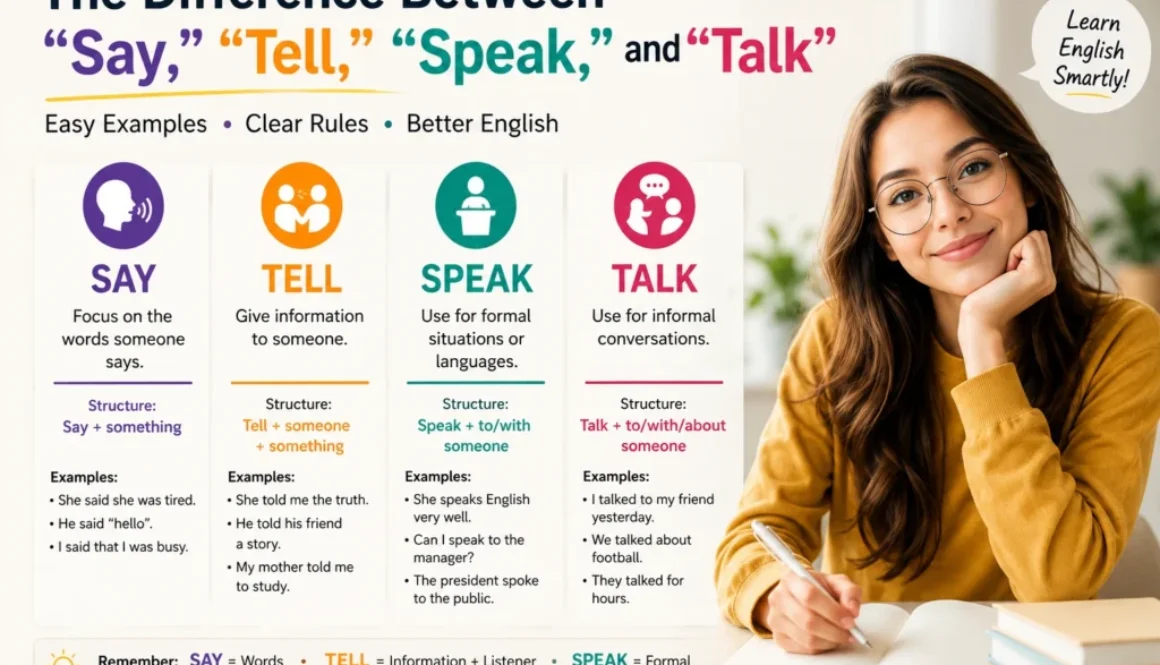
11. Confusing “Say” and “Tell”
❌ Incorrect:
- He said me the truth.
✅ Correct:
- He told me the truth.
Explanation:
Use:
- “Tell” + person
- “Say” without person
More Examples:
- She told me a story.
- He said he was tired.
12. Saying: “I am here since Monday”
❌ Incorrect:
- I am here since Monday.
✅ Correct:
- I have been here since Monday.
Explanation:
Use present perfect for actions continuing until now.
More Examples:
- She has lived here since childhood.
- We have studied English for years.
13. Saying: “One of my friend”
❌ Incorrect:
- One of my friend is a doctor.
✅ Correct:
- One of my friends is a doctor.
Explanation:
Use plural nouns after “one of.”
More Examples:
- One of my teachers is from Canada.
- One of the students won the prize.
14. Confusing “Fun” and “Funny”
❌ Incorrect:
- The movie was very fun.
✅ Correct:
- The movie was very funny.
OR - The movie was a lot of fun.
Explanation:
- “Funny” = makes you laugh
- “Fun” = enjoyable
More Examples:
- The comedian was funny.
- The trip was fun.
15. Saying: “I look forward to meet you”
❌ Incorrect:
- I look forward to meet you.
✅ Correct:
- I look forward to meeting you.
Explanation:
After “look forward to,” use a verb ending in “-ing.”
More Examples:
- I look forward to hearing from you.
- She looks forward to traveling.
16. Confusing “Much” and “Many”
❌ Incorrect:
- I have much friends.
✅ Correct:
- I have many friends.
Explanation:
- “Many” for countable nouns
- “Much” for uncountable nouns
More Examples:
- We don’t have much time.
- She bought many books.
17. Saying: “He is married with”
❌ Incorrect:
- He is married with Anna.
✅ Correct:
- He is married to Anna.
More Examples:
- She is married to a doctor.
- My uncle is married to a teacher.
18. Saying: “Discuss about”
❌ Incorrect:
- We discussed about the problem.
✅ Correct:
- We discussed the problem.
Explanation:
“Discuss” does not need “about.”
More Examples:
- They discussed the project.
- We discussed our plans.
19. Saying: “Depends of”
❌ Incorrect:
- It depends of the weather.
✅ Correct:
- It depends on the weather.
More Examples:
- Success depends on hard work.
- The trip depends on money.
20. Saying: “I have 25 years”
❌ Incorrect:
- I have 25 years.
✅ Correct:
- I am 25 years old.
More Examples:
- She is 30 years old.
- My brother is 18 years old.
21. Confusing “Do” and “Make”
❌ Incorrect:
- I made my homework.
✅ Correct:
- I did my homework.
Explanation:
Use:
- “Do” for tasks and work
- “Make” for creating something
More Examples:
- She made a cake.
- He did the dishes.
22. Saying: “Advices”
❌ Incorrect:
- She gave me many advices.
✅ Correct:
- She gave me a lot of advice.
Explanation:
“Advice” is uncountable.
More Examples:
- Thank you for your advice.
- He gave useful advice.
23. Saying: “Informations”
❌ Incorrect:
- I need more informations.
✅ Correct:
- I need more information.
Explanation:
“Information” is uncountable.
More Examples:
- This information is important.
- Can you give me more information?
24. Saying: “I enjoy to read”
❌ Incorrect:
- I enjoy to read books.
✅ Correct:
- I enjoy reading books.
Explanation:
After “enjoy,” use a verb ending in “-ing.”
More Examples:
- She enjoys cooking.
- We enjoy traveling.
25. Confusing “Lose” and “Loose”
❌ Incorrect:
- Don’t loose your keys.
✅ Correct:
- Don’t lose your keys.
Explanation:
- “Lose” = cannot find
- “Loose” = not tight
More Examples:
- I lost my wallet.
- These shoes are loose.
26. Saying: “Very delicious”
❌ Incorrect:
- The food is very delicious.
✅ Correct:
- The food is delicious.
Explanation:
“Delicious” already has a strong meaning.
More Examples:
- The cake was delicious.
- Her cooking is delicious.
27. Saying: “Open the TV”
❌ Incorrect:
- Open the TV.
✅ Correct:
- Turn on the TV.
More Examples:
- Turn on the lights.
- She turned on the computer.
28. Saying: “Close the light”
❌ Incorrect:
- Close the light.
✅ Correct:
- Turn off the light.
More Examples:
- Please turn off the fan.
- He turned off the radio.
29. Confusing “Borrow” and “Lend”
❌ Incorrect:
- Can you borrow me your pen?
✅ Correct:
- Can you lend me your pen?
Explanation:
- Borrow = take temporarily
- Lend = give temporarily
More Examples:
- I borrowed a book from him.
- She lent me some money.
30. Saying: “I am understanding”
❌ Incorrect:
- I am understanding the lesson.
✅ Correct:
- I understand the lesson.
Explanation:
Some verbs are usually not used in continuous form.
More Examples:
- I know the answer.
- She believes your story.
Why Learning Common English Mistakes Is Important
Understanding common English mistakes helps you:
- Speak English more fluently
- Write correctly
- Improve grammar skills
- Sound more natural
- Increase confidence in conversations
- Prepare for IELTS and TOEFL exams
Many English learners repeat the same mistakes for years. When you practice the correct forms every day, your English improves much faster.
Tips to Avoid English Mistakes
1. Read English Daily
Reading improves grammar and vocabulary naturally.
2. Listen to Native Speakers
Watch English videos, podcasts, and movies.
3. Practice Speaking
Use English every day, even for a few minutes.
4. Learn from Your Errors
Mistakes are part of learning. Correct them and continue practicing.
5. Write Example Sentences
Writing helps you remember grammar rules better.
Final Thoughts
Making mistakes is normal when learning English. Every intermediate student makes grammar and speaking errors. The important thing is to notice your mistakes and practice the correct forms regularly.
This guide to 30 common English mistakes intermediate students make will help you improve your English speaking, writing, listening, and grammar skills step by step.
Keep practicing every day, and your English will become more natural, fluent, and confident!