
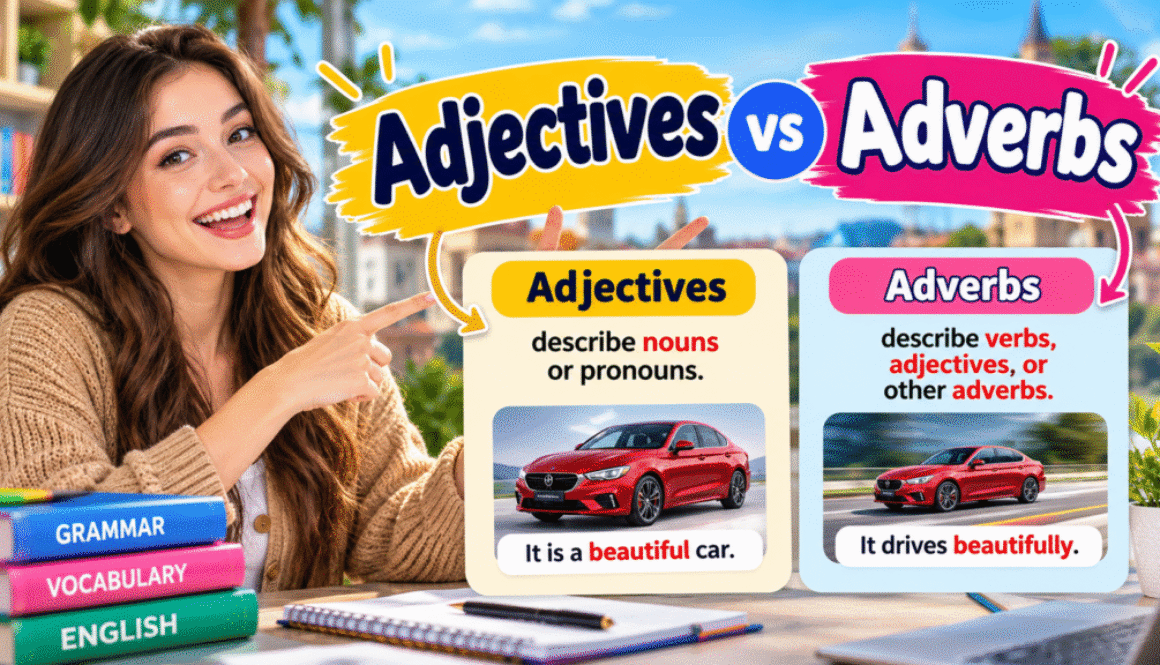
Adjectives vs Adverbs: The Complete English Grammar Guide
Adjectives vs Adverbs: Complete Guide to the Difference, Rules, Examples, and Common Mistakes
Adjectives and adverbs are two of the most important parts of English grammar. They help us describe people, things, actions, and situations more clearly. However, many English learners confuse adjectives with adverbs because they can look similar and sometimes come from the same word.
For example:
- She is a beautiful singer.
- She sings beautifully.
In the first sentence, beautiful is an adjective because it describes the noun singer. In the second sentence, beautifully is an adverb because it describes the verb sings.
In this complete guide, you will learn the difference between adjectives and adverbs, how to use them correctly, how to form adverbs from adjectives, important rules, common mistakes, and many easy examples.
What Is an Adjective in English Grammar?
An adjective is a word that describes or gives more information about a noun or pronoun.
Adjectives can tell us:
- What something is like
- How someone feels
- What color something is
- How big or small something is
- How old something is
- How many there are
- What something looks like
Examples of adjectives
- a beautiful girl
- a big house
- an interesting book
- a difficult exam
- a happy child
- a red car
- an expensive phone
Look at these examples:
She has a beautiful voice.
The adjective beautiful describes the noun voice.
I bought a new computer.
The adjective new describes the noun computer.
They live in a large house.
The adjective large describes the noun house.
What Is an Adverb in English Grammar?
An adverb is a word that gives more information about a verb, adjective, another adverb, or sometimes an entire sentence.
Adverbs often tell us:
- How something happens
- When something happens
- Where something happens
- How often something happens
- To what degree something happens
Examples of adverbs
- slowly
- quickly
- carefully
- quietly
- loudly
- happily
- yesterday
- often
- always
- very
- extremely
For example:
He drives carefully.
The adverb carefully tells us how he drives.
She speaks slowly.
The adverb slowly tells us how she speaks.
They arrived yesterday.
The adverb yesterday tells us when they arrived.
Adjectives vs Adverbs: What Is the Main Difference?
The easiest way to understand the difference is to remember:
Adjectives describe nouns or pronouns.
Adverbs describe verbs, adjectives, or other adverbs.
Compare these sentences:
He is a careful driver.
Careful is an adjective because it describes the noun driver.
He drives carefully.
Carefully is an adverb because it describes the verb drives.
Another example:
She is a beautiful singer.
Beautiful → adjective → describes singer.
She sings beautifully.
Beautifully → adverb → describes sings.
This is one of the most important differences between adjectives and adverbs in English.
Adjectives After the Verb “To Be”
One important rule is that adjectives often come after linking verbs, especially forms of be.
Common forms of be include:
- am
- is
- are
- was
- were
- be
- been
- being
Examples:
She is happy.
He is tired.
They are excited.
The food was delicious.
The students were quiet.
Notice that we use adjectives, not adverbs, after be.
Incorrect:
She is happily.
Correct:
She is happy.
Why?
Because happy describes the subject she.
Adjectives After Linking Verbs
Adjectives can also come after other linking verbs.
Some common linking verbs are:
- seem
- look
- feel
- smell
- taste
- sound
- become
- appear
- remain
- get
Examples:
You look tired.
The soup tastes delicious.
The music sounds beautiful.
I feel happy.
She became angry.
Here, the words tired, delicious, beautiful, happy, and angry are adjectives.
They describe the subject rather than directly describing an action.
Adverbs Usually Describe Actions
Adverbs are often used to describe how an action happens.
Compare:
He is a slow driver.
He drives slowly.
Slow describes the noun driver.
Slowly describes the verb drives.
More examples:
She is a quiet person.
She speaks quietly.
He is a careful student.
He studies carefully.
They are quick workers.
They work quickly.
This is a very useful pattern for English learners.
How to Form Adverbs From Adjectives
Many English adverbs are formed by adding -ly to an adjective.
Adjective → Adverb
| Adjective | Adverb |
|---|---|
| quick | quickly |
| slow | slowly |
| careful | carefully |
| beautiful | beautifully |
| quiet | quietly |
| loud | loudly |
| polite | politely |
| serious | seriously |
| easy | easily |
| happy | happily |
Examples
He is a quick learner.
He learns quickly.
She is a careful driver.
She drives carefully.
He is a polite student.
He speaks politely.
Adjectives Ending in -y
When an adjective ends in -y, we often change y to i and add -ly.
Examples:
happy → happily
easy → easily
angry → angrily
heavy → heavily
noisy → noisily
For example:
She is a happy child.
She smiled happily.
Another example:
This exercise is easy.
The students completed it easily.
Adjectives Ending in -le
For many adjectives ending in -le, the final e changes to y.
Examples:
- simple → simply
- gentle → gently
- terrible → terribly
- comfortable → comfortably
Examples:
He explained the lesson simply.
She spoke gently to the child.
Adjectives Ending in -ic
Many adjectives ending in -ic form their adverbs with -ally.
Examples:
- basic → basically
- automatic → automatically
- dramatic → dramatically
- energetic → energetically
- scientific → scientifically
Example:
He explained the problem basically.
However, there are exceptions, so learners should not assume that every adjective follows the same pattern.
Important Adverbs That Do Not End in -ly
Not every adverb ends in -ly.
Some common adverbs have the same form as adjectives.
Examples:
- fast
- hard
- late
- early
- straight
- high
- low
- right
- wrong
Look at these examples:
He is a fast runner.
He runs fast.
We do not normally say:
He runs fastly. ❌
The correct sentence is:
He runs fast. ✅
Another example:
She is a hard worker.
She works hard.
Not:
She works hardly. ❌
Be careful because hard and hardly have different meanings.
Hard vs Hardly
This is one of the most common mistakes in English.
Hard
Hard means with a lot of effort.
He works hard.
Meaning: He puts a lot of effort into his work.
Hardly
Hardly means almost not.
He hardly works.
Meaning: He works very little or almost never.
Compare:
She studies hard.
She puts a lot of effort into studying.
She hardly studies.
She almost does not study.
The meaning changes completely.
Good vs Well
Another very common problem is good vs well.
Good is normally an adjective.
Well is commonly an adverb.
Compare:
She is a good singer.
She sings well.
In the first sentence, good describes the noun singer.
In the second sentence, well describes the verb sings.
More examples:
He is a good student.
He studies well.
She is a good cook.
She cooks well.
However, well can also be an adjective when talking about someone’s health.
I am well.
She is well now.
Fast vs Fastly
Fast can be both an adjective and an adverb.
Adjective:
He has a fast car.
Adverb:
He drives fast.
We do not normally use fastly.
Another example:
She is a fast runner.
She runs fast.
Late vs Lately
Be careful with late and lately because they have different meanings.
Late
Means after the expected time.
He arrived late.
Lately
Means recently.
I haven’t seen him lately.
So:
She arrived late.
means she arrived after the expected time.
But:
She has been very busy lately.
means she has been very busy recently.
Adverbs Can Describe Adjectives
Adverbs do not only describe verbs. They can also describe adjectives.
Look at this sentence:
She is very beautiful.
The word very is an adverb. It modifies the adjective beautiful.
Other examples:
He is extremely tired.
The exam was really difficult.
This book is quite interesting.
The car is very expensive.
Here:
- very → describes beautiful
- extremely → describes tired
- really → describes difficult
- quite → describes interesting
Adverbs Can Describe Other Adverbs
An adverb can also modify another adverb.
For example:
He runs very quickly.
Quickly is an adverb.
Very modifies the adverb quickly.
Another example:
She speaks extremely slowly.
Slowly tells us how she speaks.
Extremely tells us the degree of slowly.
Adverbs of Frequency
Adverbs of frequency tell us how often something happens.
Common adverbs of frequency include:
- always
- usually
- often
- sometimes
- rarely
- seldom
- never
Examples:
I always drink coffee in the morning.
She usually walks to work.
They often visit their parents.
He sometimes plays football.
We never eat late at night.
These words are extremely useful in everyday English.
Adverbs of Time
Adverbs of time tell us when something happens.
Examples include:
- today
- yesterday
- tomorrow
- now
- soon
- later
- recently
- already
- yet
Examples:
I will call you tomorrow.
She arrived yesterday.
We are leaving soon.
He has already finished his homework.
I haven’t finished yet.
Adverbs of Place
Adverbs of place tell us where something happens.
Examples include:
- here
- there
- everywhere
- nowhere
- outside
- inside
- upstairs
- downstairs
Examples:
Come here.
Your shoes are outside.
I looked everywhere.
The children are playing upstairs.
Adverbs of Manner
Adverbs of manner tell us how an action happens.
Many of them end in -ly.
Examples:
- slowly
- quickly
- carefully
- quietly
- loudly
- beautifully
- easily
- happily
Examples:
She answered the question correctly.
He opened the door quietly.
They worked carefully.
The children played happily.
Common Mistakes With Adjectives and Adverbs
English learners often make mistakes when choosing between adjectives and adverbs.
Mistake 1
She sings beautiful. ❌
Correct:
She sings beautifully. ✅
Because beautifully describes the verb sings.
Mistake 2
He is happily. ❌
Correct:
He is happy. ✅
Because happy describes the subject after the linking verb is.
Mistake 3
He drives very careful. ❌
Correct:
He drives very carefully. ✅
Because carefully describes the verb drives.
Mistake 4
She speaks English fluent. ❌
Correct:
She speaks English fluently. ✅
Because fluently describes the verb speaks.
Mistake 5
He works hardly. ❌
If you mean that he puts a lot of effort into his work, say:
He works hard. ✅
Adjectives vs Adverbs: Easy Comparison
Use this simple rule:
Adjective → describes a noun or pronoun.
Adverb → describes a verb, adjective, or another adverb.
Compare:
He is a careful driver.
Careful → adjective → driver.
He drives carefully.
Carefully → adverb → drives.
Another example:
She is a beautiful dancer.
Beautiful → adjective.
She dances beautifully.
Beautifully → adverb.
A Simple Trick to Identify Adjectives and Adverbs
When you are not sure whether a word is an adjective or an adverb, ask yourself:
Question 1: What does the word describe?
If it describes a noun, it is probably an adjective.
a beautiful house
What kind of house? Beautiful.
Question 2: Does it describe an action?
If it describes how an action happens, it is probably an adverb.
She sings beautifully.
How does she sing? Beautifully.
This simple technique can help you choose the correct form in many English grammar exercises.
Adjectives vs Adverbs: Final Examples
Here are some useful pairs to remember:
He is a slow driver.
He drives slowly.
She is a careful student.
She studies carefully.
He is a quiet person.
He speaks quietly.
She is a beautiful singer.
She sings beautifully.
He is a quick learner.
He learns quickly.
They are happy children.
They played happily.
He is a good worker.
He works well.
Conclusion: Adjectives vs Adverbs
Understanding the difference between adjectives and adverbs is essential for speaking and writing correct English.
Remember the basic rule:
Adjectives describe nouns and pronouns.
Adverbs describe verbs, adjectives, and other adverbs.
For example:
She is a careful driver.
She drives carefully.
The adjective careful describes the noun driver, while the adverb carefully describes the verb drives.
Also remember that not every adverb ends in -ly. Words such as fast, hard, early, and late can be used as adverbs without -ly. Be especially careful with pairs such as good/well, hard/hardly, and late/lately, because their meanings and grammatical uses can be different.
The best way to master adjectives and adverbs is to learn them through examples, reading, writing, and regular practice. Once you understand what each word describes, choosing between an adjective and an adverb becomes much easier.