Articles in English: A, An, and The Explained
Articles in English: A, An, and The Explained with Easy Rules and Examples
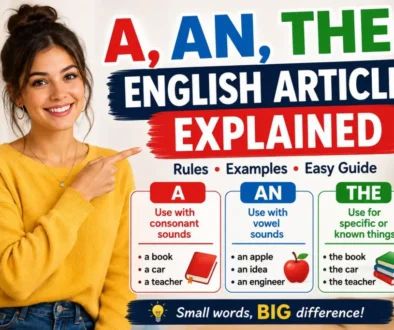
Learning how to use articles in English (A, An, and The) is one of the most important steps for English learners. Articles are small words, but they can completely change the meaning of a sentence.
Many English learners know the basic rules, but they still make mistakes when deciding whether to use a, an, the, or no article.
In this complete guide, you will learn when to use A, An, and The, the difference between definite and indefinite articles, when not to use an article, and many simple examples that you can use in everyday English.
Whether you are a beginner or an intermediate English learner, this lesson will help you understand English articles more clearly.
What Are Articles in English?
An article is a small word that comes before a noun.
There are three articles in English:
- A
- An
- The
We can divide them into two main groups:
Indefinite Articles
A and An are called indefinite articles.
We use them when we talk about one person, animal, place, or thing that is not specific.
Examples:
- I saw a dog in the street.
- She bought a book.
- He is an engineer.
- I need an umbrella.
The listener does not know exactly which dog, book, or umbrella we mean.
Definite Article
The is called the definite article.
We use the when we are talking about a specific person, place, animal, or thing.
Examples:
- I saw a dog. The dog was very friendly.
- Please close the door.
- Where is the book I gave you?
- The teacher is in the classroom.
When Do We Use “A” in English?
We use a before a singular countable noun when the following word begins with a consonant sound.
Examples:
- a book
- a car
- a house
- a teacher
- a student
- a phone
- a university
Notice that the rule is based on the sound, not simply the first letter.
Examples in sentences
- I have a car.
- She is a teacher.
- He bought a new phone.
- We live in a small house.
- I need a pen.
We usually use a when we mention something for the first time.
For example:
I saw a man in the street.
We don’t know which man. He is being introduced for the first time.
Later, we can say:
The man was wearing a black jacket.
Now we know which man we are talking about.
When Do We Use “An”?
We use an before a singular countable noun when the next word begins with a vowel sound.
The vowel sounds are generally:
a, e, i, o, u
Examples:
- an apple
- an egg
- an elephant
- an idea
- an orange
- an umbrella
Examples in sentences
- I ate an apple.
- She has an English book.
- He is an engineer.
- We saw an elephant.
- I need an umbrella.
But remember: we use an based on sound, not spelling.
For example:
an hour
The word “hour” starts with the letter h, but the h is silent. The word begins with a vowel sound: /aʊər/.
Therefore:
✅ an hour
❌ a hour
Another example:
an honest person
The h is silent.
✅ He is an honest man.
A or An? The Important Rule
The easiest way to remember the difference is:
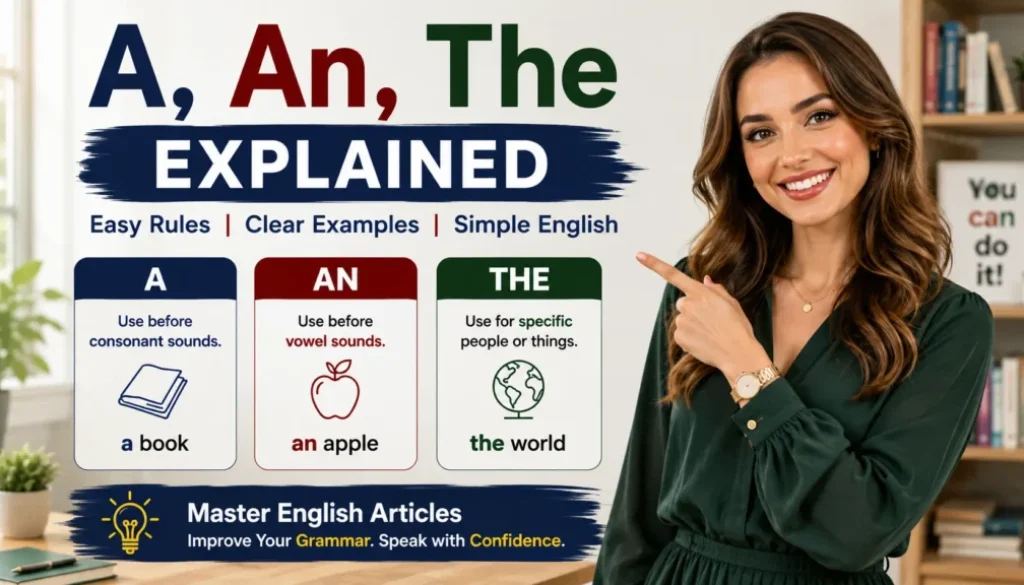
Use A before a consonant sound and AN before a vowel sound.
Look at these examples:
| A | An |
|---|---|
| a car | an apple |
| a dog | an elephant |
| a house | an hour |
| a teacher | an engineer |
| a university | an umbrella |
| a European country | an honest person |
Notice something interesting:
A university
We say:
a university
Why?
Because “university” begins with a /juː/ sound, similar to “you.”
So:
✅ a university
❌ an university
A European
We also say:
a European
because the word starts with a /j/ sound.
An hour
We say:
an hour
because the “h” is silent.
This is why pronunciation is important when learning a and an.
When Do We Use “The”?
The is the definite article.
We use the when we are talking about a specific person or thing that the listener can identify.
For example:
Please open the window.
We mean a specific window, probably the window in the room.
Another example:
I bought a new laptop. The laptop is very fast.
The first time we mention it, we use a.
The second time, we use the because we now know which laptop we mean.
A vs. The: What Is the Difference?
This is one of the most important differences in English.
Compare:
I saw a dog.
This means I saw one dog, but I am not talking about a specific dog that you already know.
Now:
The dog was very big.
Now I am talking about the specific dog that I mentioned before.
Another example
She bought a dress yesterday.
We don’t know which dress.
The dress is beautiful.
Now we know which dress because it was already mentioned.
So the basic pattern is:
First mention → A/An
Second mention → The
Example:
I saw a man outside my house. The man was carrying a bag.
Use “The” for Something Specific
We use the when both the speaker and listener know what we are talking about.
Examples:
- Please turn off the light.
- Where is the bathroom?
- Open the door, please.
- Can you pass me the salt?
- I left my phone on the table.
For example, if you are sitting in a room with one main door, you can say:
Close the door.
You don’t need to say which door because the context makes it clear.
Use “The” for Unique Things
We often use the when there is only one of something in a particular context.
Examples:
- the sun
- the moon
- the Earth
- the sky
- the internet
Examples in sentences:
- The sun is very bright today.
- The Earth moves around the sun.
- Look at the sky!
- I found the information on the internet.
Articles with Jobs and Professions
When we talk about someone’s profession after be, we normally use a or an.
Examples:
- I am a teacher.
- She is a doctor.
- He is an engineer.
- My brother is a student.
- She wants to become an actress.
A common mistake is:
❌ I am teacher.
Correct:
✅ I am a teacher.
Because “teacher” is a singular countable noun.
Articles with Singular Countable Nouns
A singular countable noun usually needs a determiner such as a, an, the, my, your, this, that, etc.
For example:
❌ I bought book.
Correct:
✅ I bought a book.
Or:
✅ I bought the book.
Or:
✅ I bought my book.
You normally cannot simply say:
I bought book.
When We Do NOT Use A or An
We do not use a/an with plural nouns.
For example:
❌ a books
❌ an apples
Correct:
✅ books
✅ apples
Examples:
- I like books.
- She bought apples.
- Dogs are friendly animals.
- Students need practice.
We also do not use a/an with uncountable nouns.
For example:
❌ a water
❌ a rice
❌ an information
Instead, we can say:
- some water
- some rice
- some information
- a bottle of water
- a bowl of rice
- a piece of information
Examples:
I need some information.
Can you give me a piece of information?
When Do We Use No Article?
Sometimes we don’t use an article at all. This is often called the zero article.
We commonly use no article when speaking generally about plural or uncountable nouns.
Plural nouns
Dogs are loyal animals.
We are talking about dogs in general.
Books can help you learn new things.
We mean books generally.
Uncountable nouns
Water is important.
English is spoken around the world.
Knowledge is powerful.
We are talking about these things in general.
Compare:
I like coffee.
Coffee in general.
But:
The coffee on the table is cold.
Now we mean a specific coffee.
Common Mistakes with A, An, and The
Let’s look at some common mistakes English learners make.
Mistake 1
❌ She is teacher.
✅ She is a teacher.
Mistake 2
❌ I have an car.
✅ I have a car.
Mistake 3
❌ He is a engineer.
✅ He is an engineer.
Mistake 4
❌ I bought a apple.
✅ I bought an apple.
Mistake 5
❌ I need an information.
✅ I need some information.
Mistake 6
❌ The dogs are friendly.
This sentence can be correct or incorrect depending on the meaning.
If you mean specific dogs:
The dogs in my neighborhood are friendly.
If you mean dogs in general:
Dogs are friendly animals.
A, An, and The: Easy Comparison
Let’s compare the three articles:
A
Use a for one non-specific singular countable noun.
I saw a bird.
An
Use an for one non-specific singular countable noun beginning with a vowel sound.
I ate an apple.
The
Use the for a specific noun.
The bird was sitting in the tree.
Simple Examples to Practice
Try to complete these sentences with a, an, the, or no article.
- I have ___ car.
- She is ___ doctor.
- He ate ___ orange.
- I saw ___ dog. ___ dog was black.
- ___ sun is shining.
- I like ___ coffee.
- She bought ___ new phone.
- He is ___ honest person.
- We live in ___ small apartment.
- ___ students in my class are very friendly.
Answers
- a
- a
- an
- a / The
- The
- no article
- a
- an
- a
- The
The Best Way to Learn English Articles
Don’t try to memorize every rule at once.
Start with these three simple ideas:
Rule 1: A
Use a for one non-specific thing with a consonant sound.
a car
a book
a teacher
Rule 2: An
Use an for one non-specific thing with a vowel sound.
an apple
an egg
an engineer
Rule 3: The
Use the when the thing is specific or already known.
I bought a car. The car is blue.
If you understand these three ideas, you already understand a large part of how English articles work.
Final Summary: A, An, and The
Articles may look like small words, but they are extremely important in English grammar.
A is used before singular countable nouns with a consonant sound:
a book, a car, a teacher
An is used before singular countable nouns with a vowel sound:
an apple, an hour, an engineer
The is used when we are talking about something specific or already known:
the book, the car, the teacher
And sometimes we use no article, especially when talking generally about plural or uncountable nouns:
Dogs are friendly.
Water is important.
I like English.
The best way to master English articles is to read, listen, speak, and practice them regularly. Don’t worry if you make mistakes at first. With enough exposure and practice, choosing between a, an, the, and no article will become much more natural.