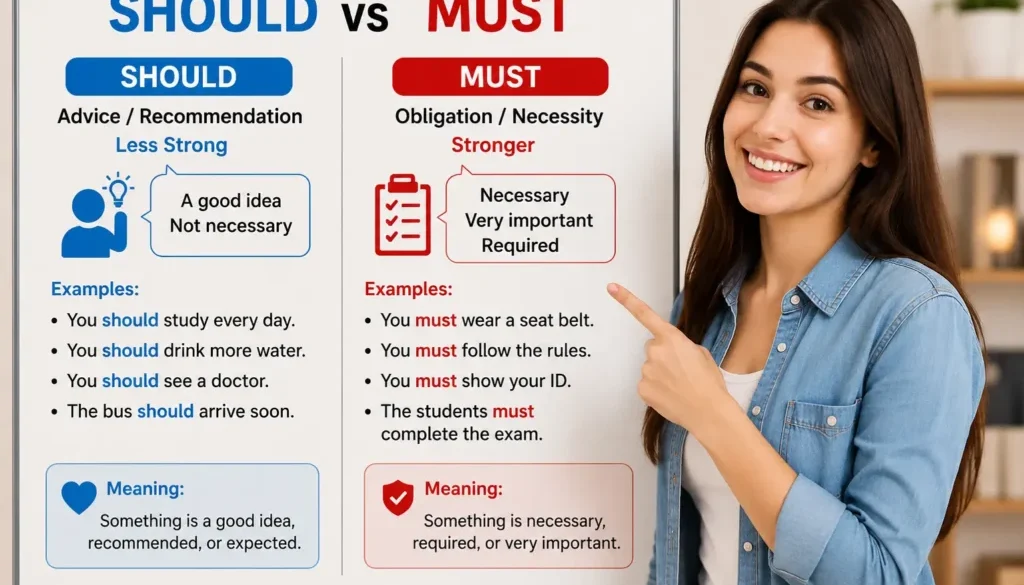
Should vs Must: Difference, Uses, and Examples
Should vs Must: What Is the Difference? A Complete Guide with Examples
Understanding the difference between should and must is essential for anyone learning English grammar. Both should and must are modal verbs, and both can be used to talk about what is necessary, expected, or a good idea. However, they do not have the same meaning or strength.
For example:
- You should study for the exam. → It is a good idea.
- You must study for the exam. → It is necessary.
The difference may seem small, but choosing the wrong modal verb can change the meaning of a sentence.
In this complete guide, you will learn when to use should and must, the difference between should and must, should vs must for obligation, advice, rules, necessity, negative sentences, questions, and everyday English conversations. You will also find many simple examples to help you use these modal verbs correctly.
🎯 Stop wasting time on random resources. Discover the English books that can help you build confidence in grammar, vocabulary, speaking, and writing. https://amzn.to/4fT1zNq
What Are Should and Must in English Grammar?
Should and must are both modal verbs.
Modal verbs are special auxiliary verbs that help us express ideas such as:
- Advice
- Obligation
- Necessity
- Possibility
- Permission
- Expectation
Other common modal verbs include can, could, may, might, will, and would.
The most important thing to remember is that should is generally weaker than must.
Compare:
You should call your mother.
This means calling your mother is a good idea.
You must call your mother.
This means calling your mother is necessary or very important.
So, we can think of them like this:
SHOULD = advice or recommendation
MUST = strong necessity or obligation
Should vs Must: The Main Difference
The easiest way to understand the difference is to think about strength.
Should
We use should when something is a good idea, recommended, or expected.
You should drink more water.
The speaker is giving advice. The person can choose whether to follow it.
Must
We use must when something is necessary, very important, or required.
You must wear a seat belt.
This sounds like a rule or strong requirement.
Compare These Sentences
You should arrive early.
→ Arriving early is recommended.
You must arrive early.
→ Arriving early is required or extremely important.
You should finish your homework.
→ It is a good idea to finish it.
You must finish your homework.
→ You are required to finish it.
This difference between should and must is one of the most important points for English learners.
🎯 Stop wasting time on random resources. Discover the English books that can help you build confidence in grammar, vocabulary, speaking, and writinghttps://amzn.to/4qa6ehj
When to Use Should in English
There are several common situations where we use should.
1. Should for Advice
The most common use of should is to give advice.
We use it when we want to tell someone what we think is a good idea.
Examples:
You should study every day.
You should get more sleep.
You should talk to your teacher.
You should practice English regularly.
You should read more books.
You should drink some water.
Notice that should does not mean the action is absolutely necessary. It means that the speaker believes it is a good choice.
Example:
I’m tired all the time.
You should get more sleep.
The speaker is giving advice, not giving a strict order.
2. Should for Recommendations
We can also use should when recommending something.
Examples:
You should visit London.
You should try this restaurant.
You should watch this movie.
You should read this book.
You should learn new vocabulary every day.
For example:
I’m going to Morocco next month.
You should visit Marrakech. It’s beautiful.
Here, should means “I recommend it.”
3. Should for Expectations
We can use should when we expect something to happen.
Examples:
The bus should arrive soon.
He should be here in ten minutes.
The package should arrive tomorrow.
She should finish the work today.
In these examples, should does not mean advice. It expresses an expectation.
For example:
The train should arrive at 8:00.
This means we expect the train to arrive at approximately 8:00.
When to Use Must in English
We use must when something is necessary or when there is a strong obligation.
1. Must for Strong Obligation
Use must when someone has a strong duty to do something.
Examples:
You must wear a seat belt.
You must follow the rules.
You must pay your taxes.
You must show your passport.
Students must complete the exam.
You must be quiet in the library.
These sentences express stronger obligation than sentences with should.
Compare:
You should wear a jacket.
This is advice.
You must wear a jacket.
This suggests that wearing the jacket is necessary.
2. Must for Rules
Must is commonly used for rules and instructions.
You can see must on signs, official instructions, websites, and notices.
Examples:
Visitors must show identification.
Employees must wear uniforms.
Passengers must remain seated.
You must not smoke here.
Students must arrive before 9:00.
These sentences communicate requirements.
3. Must for Strong Necessity
We can also use must when something is extremely important or necessary.
Examples:
I must finish this work today.
We must leave now.
You must remember this rule.
I must call my father.
We must find a solution.
For example:
It’s already 10 p.m. We must go home.
The speaker feels that going home is necessary.
Should vs Must for Advice and Obligation
This is where English learners often become confused.
Consider these two sentences:
You should see a doctor.
You must see a doctor.
The first sentence is advice. The second sentence is much stronger and suggests that seeing a doctor is necessary.
Another example:
You should exercise more.
This means:
“I recommend exercising more.”
But:
You must exercise every day.
This means:
“It is necessary or required for you to exercise every day.”
Therefore, use should when you want to recommend something and must when you want to express strong necessity or obligation.
Should vs Must: A Simple Comparison Table
| Should | Must |
|---|---|
| Advice | Strong obligation |
| Recommendation | Necessity |
| Something is a good idea | Something is required |
| Weaker | Stronger |
| Personal recommendation | Rule or strong requirement |
| Expected action | Essential action |
Examples:
You should study English.
→ It is a good idea.
You must study for the exam.
→ It is necessary.
You should arrive early.
→ I recommend arriving early.
You must arrive before 8:00.
→ This is a requirement.
Should Not vs Must Not
The negative forms are extremely important.
Should not / shouldn’t
Shouldn’t means something is not recommended or is a bad idea.
You shouldn’t eat so much sugar.
You shouldn’t stay up so late.
You shouldn’t be rude to people.
You shouldn’t spend all your money.
The person is giving advice.
Must not / mustn’t
Mustn’t means something is prohibited or not allowed.
You mustn’t smoke here.
You mustn’t touch this machine.
You mustn’t enter this room.
You mustn’t drive without a license.
This is much stronger than shouldn’t.
Compare:
You shouldn’t use your phone during class.
This means it is a bad idea.
You mustn’t use your phone during the exam.
This means it is forbidden.
This distinction is extremely important in everyday English.
Shouldn’t vs Mustn’t: Important Difference
Many English learners make the mistake of thinking that shouldn’t and mustn’t have the same meaning.
They don’t.
Shouldn’t = It is a bad idea.
You shouldn’t drive when you’re tired.
Mustn’t = It is forbidden.
You mustn’t drive without a license.
The first sentence gives advice.
The second sentence describes a rule or prohibition.
Should and Must in Questions
We can use should in questions when asking for advice or opinions.
Examples:
Should I call him?
Should I take an umbrella?
Should we leave now?
Should I learn English every day?
What should I do?
These questions are very common in everyday conversations.
Example:
I’m not feeling well. Should I go home?
Yes, you should.
Can We Use Must in Questions?
Yes, but must is less common when asking for everyday advice.
For example:
Must I finish this today?
This asks whether something is required.
A more natural alternative in many situations is:
Do I have to finish this today?
For example:
Must I wear a uniform?
means:
Is it required that I wear a uniform?
Should vs Must in Everyday English
Understanding the difference becomes easier when you see these verbs in real situations.
At School
Students should read every day.
This is advice.
Students must wear their school uniforms.
This is a rule.
At Work
You should check your emails regularly.
This is a recommendation.
Employees must wear an ID badge.
This is a requirement.
At Home
You should clean your room.
This is advice.
You must turn off the lights before leaving.
This expresses a strong requirement.
While Driving
You should drive carefully.
This is advice.
You must stop at a red light.
This is a rule.
Should Have vs Must Have
There is another important grammar point: should have and must have.
Should Have
Should have + past participle can express regret, criticism, or something that was expected but did not happen.
Examples:
You should have studied harder.
I should have called you.
She should have arrived earlier.
We should have left sooner.
For example:
I failed the exam. I should have studied more.
The speaker is looking back and saying that studying more would have been the better choice.
Must Have
Must have + past participle can express a strong conclusion about the past.
Examples:
He must have forgotten.
She must have missed the bus.
They must have gone home.
For example:
John isn’t here. He must have gone home.
The speaker does not know for certain, but the evidence makes the conclusion very likely.
Common Mistakes with Should and Must
Mistake 1: Using “to” after should
❌ You should to study English.
✅ You should study English.
After should, use the base form of the verb.
Correct structure:
Subject + should + base verb
I should study.
She should work.
They should leave.
Mistake 2: Using “to” after must
❌ You must to go.
✅ You must go.
The same rule applies to must.
Correct structure:
Subject + must + base verb
I must work.
He must study.
We must leave.
Should vs Must: The Easiest Rule to Remember
If you are confused, ask yourself one simple question:
Is this advice or is this necessary?
If it is advice, use should.
You should exercise.
If it is necessary or required, use must.
You must wear a helmet.
Remember:
SHOULD → “This is a good idea.”
MUST → “This is necessary.”
That simple distinction will help you choose the correct modal verb in most everyday situations.
Final Summary: Should vs Must
Both should and must are important modal verbs in English grammar, but they express different levels of obligation.
Use should for:
- Advice
- Recommendations
- Suggestions
- Expectations
Examples:
You should study more.
You should visit Paris.
You should talk to your teacher.
The bus should arrive soon.
Use must for:
- Strong obligation
- Rules
- Requirements
- Necessity
Examples:
You must wear a seat belt.
You must follow the rules.
You must finish your work.
Visitors must show their passports.
And remember the negative forms:
shouldn’t = not recommended
mustn’t = not allowed
The key is not to memorize hundreds of complicated grammar rules. Understand the strength of the meaning.
When you are giving someone advice, should is usually the right choice.
When something is necessary, required, or forbidden, must is usually stronger and more appropriate.
The more you practice these differences in real sentences, the more naturally you will use should and must when speaking and writing English.